About a year ago, I discovered Phil Gates’ newsletter, Phil’s Substack. Gates is a botanist, a naturalist, and a Country Diarist for the Guardian. His newsletter often documents the flora and fauna that he encounters on his walks, complete with great photos. He also has a lovely collection of old books that he occasionally writes about and shares images from.
One of the books he has highlighted is his grandmother’s copy of The Language of Flowers. Before reading his post on the book, I had only heard of it in passing on social media. I had initially thought it to be a single book. However, after reading about it in Gates’ newsletter, I did a little research and soon realized that it is actually a genre of books—many with the same (or similar) title. I have also learned that these books were extremely popular during the Victorian era, have a strong connection to poetry, and have influenced set design in the show, Bridgerton.
Floriography and the Language of Flowers
The language of flowers books are based on the tradition of floriography (using flowers to send messages). According to “Written in Petals: The Language of Flowers in Victorian Europe” (an online exhibition found on the Cornell University Library website), floriography “is an ancient art, rooted in the symbolism of China, Egypt, and Assyria.” However, the British tradition of floriography seems to have come from France.
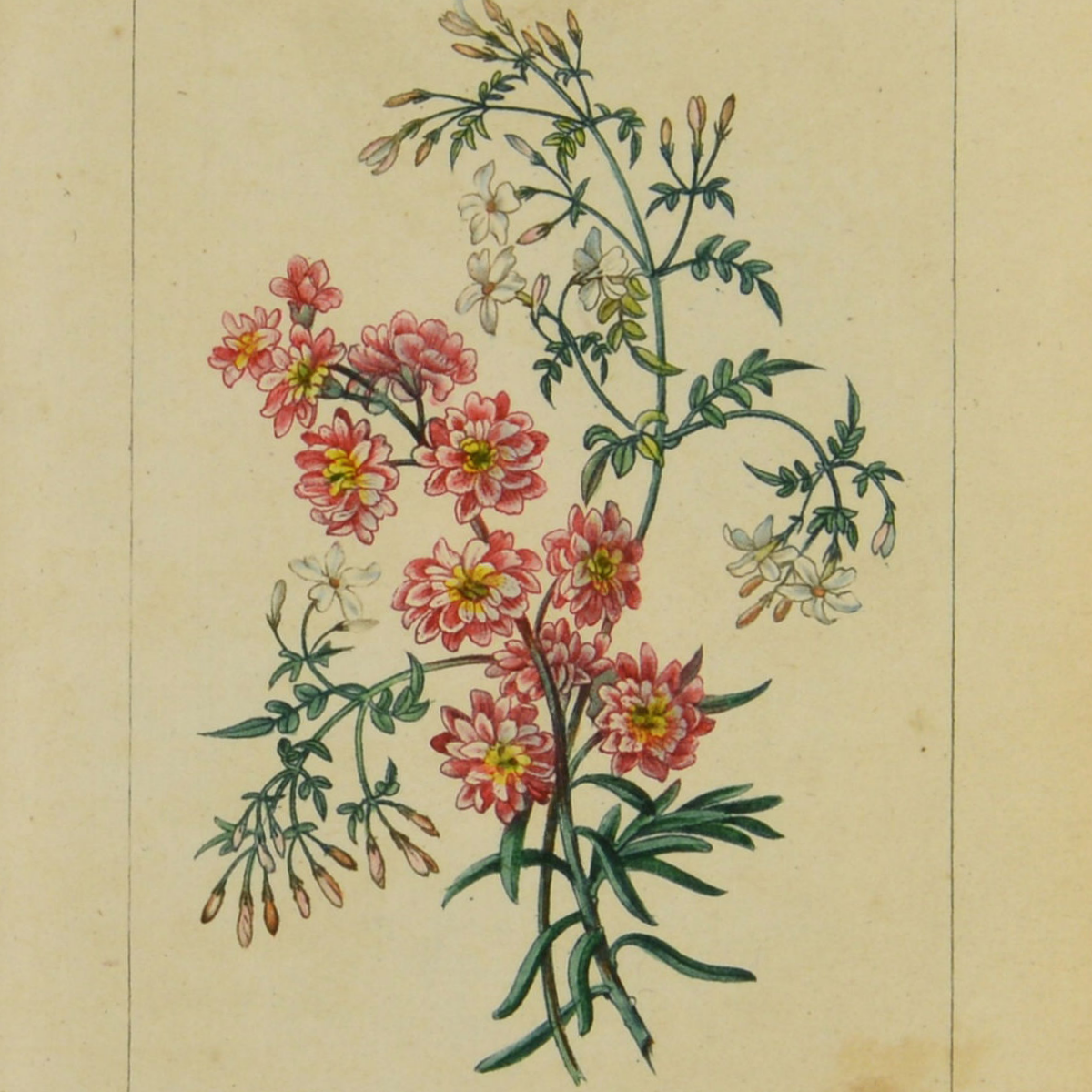
The “Written in Petals” exhibition explains that the book, Le Langage Des Fleurs by Charlotte de La Tour, was “the first completely devoted to floriography and was translated and published widely.” The exhibition notes that de La Tour’s book provided the model for language of flowers books in Britain.

During the nineteenth century, these books were prominently displayed and consulted in middle-class homes in Britain, the US, and France. The online exhibition explains that Victorian women in the middle and upper class weren’t encouraged to pursue occupations or higher education; rather, they were expected to care for their children and home.
By extension, maintaining a garden and learning about horticulture was in keeping with a Victorian woman’s pursuits. Knowing the language of flowers allowed women to set the tone of their home and express their feelings through floral arrangements and flowers in their hats.
What Does a Language of Flowers Book Include?
The common element found in language of flowers books is the inclusion of a floral dictionary, which often takes the form of two alphabetical lists: one sorted by flowers and the sentiment they convey and another by sentiment and their corresponding flower. Using the first list, a reader could easily determine what meaning a flower held. Likewise, if a person wanted to send a particular message to someone, they could look up the sentiment and use the correct flower.

Using the pages displayed above from The Language of Flowers: An Alphabet of Floral Emblems published by T. Nelson and Sons, you can see that a red tulip is a “declaration of love,” while a yellow rose signifies “jealousy” or “decrease of love.” If you want to call someone “a boaster,” you might give them a hydrangea. But if you wish to let a friend know that they are “comforting,” you could present them with a scarlet geranium.
In his post, “Say it with flowers … but choose your blooms carefully,” Phil Gates warns that these books did not always list the same sentiments and that flower meanings could change over time. He writes: “To avoid misunderstanding, giver and receiver need to be reading from that same code book.”
You may have noticed that the book pages pictured above also include trees and other plants in addition to flowers. The “Written in Petals” exhibition explains that during the 19th century in Britain and the US, “botany and the growing of plants became a serious hobby for vast numbers of women.” The exhibition further notes that the language of flowers formed a portion of the literature created for botanical hobbyists.
Additionally, some of these books offer information on practical uses and benefits of plants and flowers. In The Language of Flowers: Including Floral Poetry published by Frederick Warne and Co., the book’s introduction includes this:
And in these days of utility, when a thing is nothing if not useful, we must remind our readers that the vegetable and floral world holds in it the secret of health to a greater degree, we believe, than is yet dreamt of in our philosophy.
Throughout the book, “mythology, history, usefulness” of different plants and flowers is sprinkled in—some within descriptive text and some through the inclusion of floral poetry. The book also provides a dial of flowers, which lists the opening and closing time of different flowers.
Odes to Flowers and Plants: The Poetry Connection
Because my creative writing background began with poetry, I was immediately drawn to language of flowers books that incorporated floral poetry into their pages. Several books I looked at, like The Language of Flowers: An Alphabet of Floral Emblems, include a selection of floral poetry at the end of the book.
However, in The Language of Flowers: Including Floral Poetry, each flower or plant is presented in a sort of floral essay with meaning, folklore, tradition, and history mingling with a variety of poems. I found the book’s entry for rosemary interesting because it references both William Shakespeare and folk traditions. Rosemary is introduced in the following way, with the publishers referring to lines from two of Shakespeare’s plays:
Our forefathers invariably adopted Rosemary as the symbol of remembrance; it was believed to possess the power of improving the memory, and was frequently employed as a means of invigorating the mental faculties. Perdita, in the “Winter’s Tale,” says:
“For you there’s rosemary and rue; these keep
Seeming and savour all the winter long:
Grace and remembrance be with you both!”
And in “Hamlet,” Ophelia says:
“There’s rosemary for you: that’s for remembrance.
Pray you, love, remember.”
![Image of Winter’s tale, Per.: Reverend sirs for you there’s rosemary ... act IV, sc. 3 [i.e. sc. IV] painted by T. Stothard R.A. and engraved by J. Neagle.](https://i0.wp.com/stephraemoran.com/wp-content/uploads/2026/02/027343-Small_1500px.jpg?resize=666%2C1024&ssl=1 "Image of Winter’s tale, Per.: Reverend sirs for you there’s rosemary ... act IV, sc. 3 [i.e. sc. IV] painted by T. Stothard R.A. and engraved by J. Neagle.")
The book then goes on to explore a folk custom connected to rosemary:
Respecting its employment at funerals, Mr. Martyn observes that in some parts of England, in his time, it was still customary to distribute it among the company, who frequently threw sprigs of it into the grave. Slips of it were also sometimes placed within the coffin; and in some secluded villages these innocent customs are still practised.
The publishers also include the poem, “To the Herb Rosemary,” by Henry Kirke White. The following stanza from the poem seems to best exemplify the custom described above. Please note that this version from the book is slightly different than other instances of the poem that can be found online:
Come, funeral flower! who lovest to dwell
With the pale corse in lonely tomb,
And throw across the deepest gloom
A sweet decaying smell.
Come, press my lips, and lie with me,
Beneath the lowly alder tree;
And we will sleep a pleasant sleep,
And not a care shall dare intrude
To break the marble solitude,
So peaceful and so deep.
Because of my interest in folk life and literature, I really enjoyed reading through this book and exploring the connection of plants and flowers to tradition and poetry.
The Use of Flowers in Bridgerton
Dearest Gentle Reader, this author is delighted to find that she has reached a point in her letter where she simply must write about Bridgerton and the show’s use of flowers. Indeed, if you enjoy watching Bridgerton then you may have noticed that the set includes a great many flowers!
In the article, “The flowers in ‘Bridgerton’ can reveal characters’ secrets: How to crack the code,” Sophie Caldwell explains that Alison Gartshore (production designer for the third season of Bridgerton) and Phillip Corps (florist for the show) used floriography in their set designs. Caldwell writes:
Floriography grew increasingly popular during the Regency era, in which “Bridgerton” is set. Gartshore and Corps say the set design for one of the season’s most elaborate balls was inspired by the language of flowers.
According to the article, one of the books they used for research was Language of Flowers illustrated by Kate Greenaway. Caldwell also describes “tulips, geraniums, lilies and roses as particularly significant flowers” in the show.

In looking at the pages from Language of Flowers shown above, it becomes apparent that roses were very complex with respect to the sentiments they represented. How wonderful to give an Austrian rose (“Thou art all that is lovely”), but I wouldn’t hand a York and Lancaster rose to anyone (“War”).
I also love Greenaway’s delicate illustrations. The “Written in Petals” exhibition explains that she was a clothing illustrator and notes that “most of the images in the book focus on women and children wearing clothes that Greenaway made popular.”
Further Reading on the Language of Flowers
I definitely recommend reading Phil Gates’s post that initially sparked my interest in the subject. In it, he imagines how “a floral courtship” might transpire via a flower dialogue (worthy of a Bridgerton episode!). It is delightful to read.
Additionally, Icy Sedgwick’s post, “The Victorian Language of Flowers: Hiding Secret Messages in Plain Sight,” explores more of the history of the language of flowers.
As ever, thank you for reading my blog. If you know someone fascinated by folklore, feel free to share this post with them.
Art credit (featured image): from a page in Le Langage Des Fleurs by Charlotte de La Tour (cropped). Public domain.