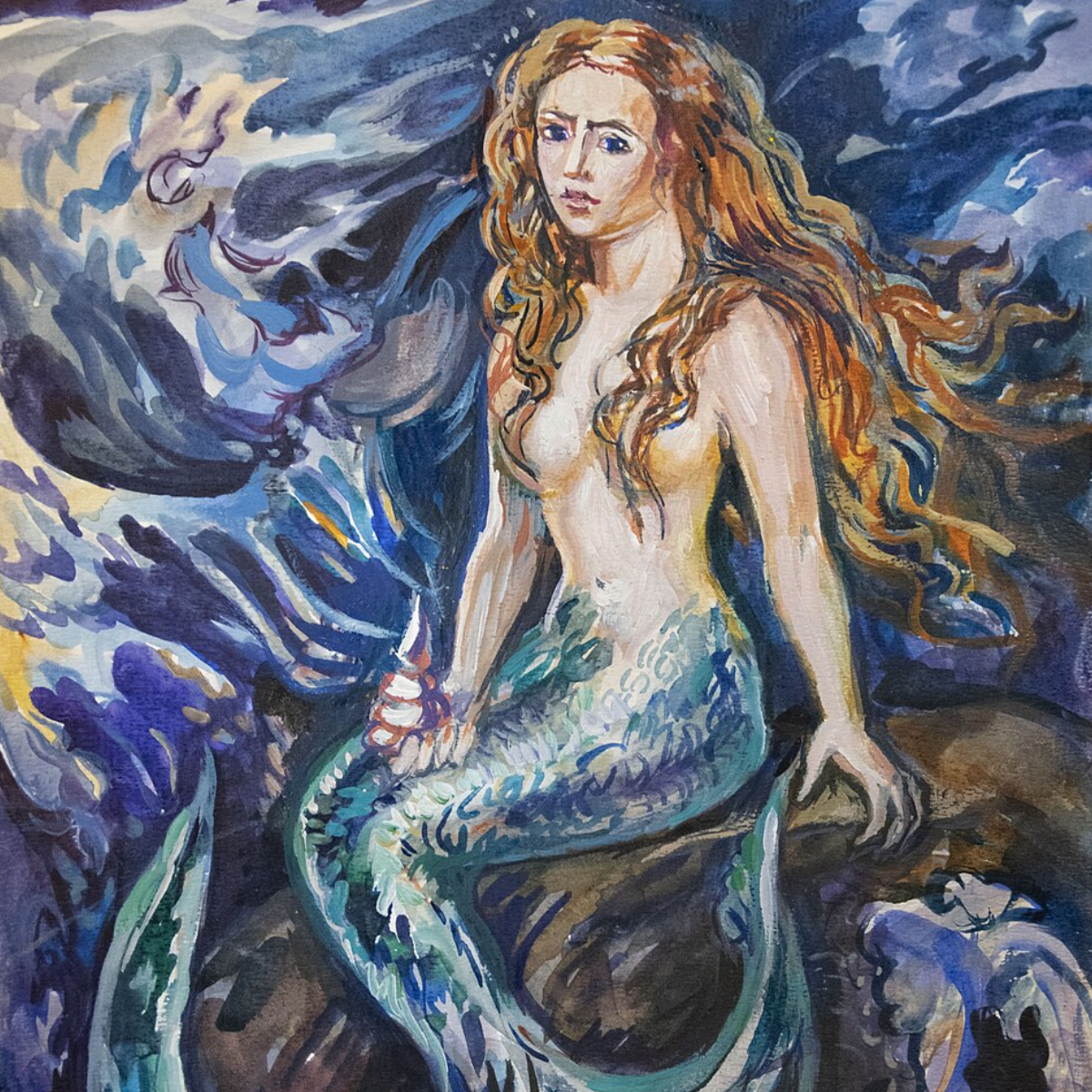
Mermaids! I’m kind of excited about this topic. 🙂 Mermaids have a long history and are found in the literature, mythology, and folklore of many different countries, so I have decided to focus primarily on the Celtic mermaid.
Additionally, I have discovered that mermaids are quite complex (which I love!), but I had to rein myself in to keep this post a reasonable length. So please consider this an introduction to the enchanting mermaid. We’ll take a quick look at her origin story, highlight some of her characteristics, and explore a few folktales that include her.
A Brief History of the Mermaid
The exact origin of the mermaid seems to be difficult to determine. She is a very old figure in both myth and legend. In the article, “The Mermaid and Her Sisters: From Archaic Goddess to Consumer Society,” Boria Sax suggests that the mermaid may stem from a mother-goddess figure like Gaia from Greek mythology.
The earliest known representation of a merperson comes from Babylon. Sax explains that Ea, the god of the sea, “was represented with the torso of a human being and the tail of a fish.” Atargatis, a Syrian goddess, was similarly depicted, but with a woman’s face and the body of a fish.
But according to “The Folklore of the Merfolk” by Sir Arthur Waugh, it is within the bestiaries where the mermaid begins to acquire characteristics that we would recognize, but through a Christian lens. Bestiaries were medieval collections, much like an encyclopedia, which offered descriptions of both real and mythical creatures and included allegories or moral themes. Waugh writes:
It is the Bestiaries which gave the mermaid all the attributes associated with her from early Christian days—her vanity, constantly with comb and mirror, her alluring appearance and voice, and her danger to the human soul. Early on in the Christian Era, a fish was a symbol of the soul; and, in medieval Church carvings, a mermaid grasping a fish is an Awful Warning to the Laity.

As time passed from the Middle Ages to the early modern period, a variety of sources influenced mermaid descriptions and representations. Sax explains: “Myth, literature, and folk belief blended in the lore of mariners during the early modern period, to create the popular image of the mermaid.” Additionally, humans still maintained a complicated relationship with the sea during this time in that they simultaneously feared and were amazed by it.
Keeping this history in mind, now let’s shift to look at folklore and attributes of the Celtic mermaid.
Characteristics of the Celtic Mermaid
In general, mermaids within Celtic folklore are presented much as they were in antiquity. Katharine Briggs lays out a succinct description of them in An Encyclopedia of Fairies: Hobgoblins, Brownies, Bogies, and Other Supernatural Creatures. She writes:
… the mermaids are like beautiful maidens from the waist upwards, but they have the tail of a fish. They carry a comb and a mirror and are often seen combing their long and beautiful hair and singing with irresistible sweetness on some rock beside the sea. They allure men to their death and their appearance is ominous of storms and disasters.
And Briggs clarifies that it wasn’t just that their presence foreshadowed some type of misfortune, but that mermaids also intentionally caused trouble like capturing men, then drowning or “devouring them.” (More on that to come.)
In The Encyclopedia of Celtic Mythology and Folklore, Patricia Monaghan adds to this idea. She explains that because it was thought that mermaids had a penchant for brandy, it was believed that several mermaids might attack a ship as a group. Once they had successfully wrecked the ship, they would scour the debris for intact bottles of brandy.
Both Monaghan and Briggs consider the mermaid to be a type of faerie, and if captured, it was believed that she might grant wishes. But be warned—Briggs notes that mermaids might tweak the wishes (most likely to their own advantage) if they could manage it.
The Irish Mermaid (Merrow) and the Scottish Highland Mermaid (Ceasg)
While all of the Celtic nations included mermaids in their folklore, there were different versions of her depending on the region. But as I researched, the Irish mermaid and the Scottish Highland mermaid stood out. The sources I consulted included extra folklore on these mermaids that went beyond the Celtic mermaid’s general attributes.

The Irish mermaid was known as the merrow (from the Irish murúch), but was also called the moruadh or moruach (“sea maid”). Both Briggs and Monaghan explain that in some early descriptions of Irish mermaids, such as one found in the Annals of the Four Masters, they are portrayed as giants.
I located an English translation of the Annals of the Four Masters, and in the annal corresponding to the year A.D. 887, there is an entry describing a mermaid. It reads:
A mermaid was cast ashore by the sea in the country of Alba. One hundred and ninety five feet was her length, eighteen feet was the length of her hair, seven feet was the length of the fingers of her hand, seven feet also was the length of her nose; she was whiter than the swan all over.
I found this description fascinating—at this size, fears of being devoured by a mermaid or her breaking apart a ship make more sense.
Another aspect of Irish mermaids was a special cap they wore called the cohuleen druith. Monaghan explains that the cap kept the mermaid safe beneath the water. However, should a human man marry a mermaid, he must take and hide her cap from her, essentially trapping her on land.
Monaghan notes that as a wife, the mermaid was “industrious, loving, sensuous.” But whether due to her capricious nature or her love for the sea, if she ever found her cap, she donned it and “escaped from land, leaving husband and children behind, without a thought or a second glance.”
In Scottish folklore, the Highland mermaid is called the Ceasg or maighdean na tuinne (“maiden of the wave”). Her body is that of a woman, but her tail is that of a young salmon (grilse). Briggs notes that if captured, the Ceasg might “be prevailed upon to grant three wishes.” Stories of her marrying humans exist, and there are sea captains believed to have been born of these marriages.
This Highland mermaid appears in a story called, “The Celtic Dragon Myth,” credited to John Francis Campbell, but published by George Henderson. In the tale, the mermaid strikes a bargain with a fisherman, then later returns to make good on the bargain by swallowing the hero of the story. The hero’s wife (a princess) plays a harp for the mermaid to entice her to open her mouth so that the hero may escape. But as he escapes, the princess is then swallowed instead. The hero must undergo a challenge in order to destroy the mermaid and save his wife.
I explored the overall narrative of “The Celtic Dragon Myth” in an article last year, which you can read here. In addition to the mermaid, the tale includes dragons, giants, and shape-shifting heroes.
Two Mermaid Folktales from Wales
As you can imagine, there are a plethora of tales and stories about mermaids. But as I hadn’t encountered much in the way of specific folklore or folktales about mermaids in Wales, I turned to Celtic Folklore: Welsh and Manx by John Rhŷs. There I discovered several tales which further illuminate the Celtic mermaid.
In Welsh, the word for “mermaid” is môr-forwyn. It is a compound word that means “sea maid.” Rhŷs relates two mermaid tales from when he was visiting Trefriw, a parish in Nant Conwy. The first comes from a man named Morris Hughes, and Rhŷs relates the story in this manner:
Lastly, Morris had a tale about a mermaid cast ashore by a storm near Conway [Conwy]. She entreated the fishermen who found her to help her back into her native element; and on their refusing to comply she prayed them to place her tail at least in the water. A very crude rhyme describes her dying of exposure to the cold, thus:—
Y forforwyn ar y traeth,
Crio gwaeddu’n arw wnaeth,
Ofn y deuai drycin drannoeth:
Yr hin yn oer a rhewi wnaeth.

The stranded mermaid on the beach
Did sorely cry and sorely screech,
Afraid to bide the morrow’s breeze:
The cold it came, and she did freeze.
But before expiring, the mermaid cursed the people of Conway to be always poor, and Conway has ever since, so goes the tale, laboured under the curse; so that when a stranger happens to bring a sovereign [a gold coin] there, the Conway folk, if silver is required [silver coins, I presume], have to send across the water to Llansanffraid for change.
This act of mermaid vengeance against the people of Conway is a common feature of mermaid tales. In his article, Sax explains that “many tales record of terrible revenge taken by mermaids on those who harmed or offended them.”
The second story has a similar setup, but a different ending. It was told to Rhŷs by a John Duncan Maclaren, whose father was from Scotland, but Maclaren himself was considered to be a Welshman. The mermaid tale he shared with Rhŷs is this:
A fisherman from Llandrillo yn Rhos, between Colwyn and Llandudno, had caught a mermaid in his net. She asked to be set free, promising that she would, in case he complied, do him a kindness. He consented, and one fine day, a long while afterwards, she suddenly peeped out of the water near him, and shouted: Siôn Ifan, cwyd dy rwyda’ a thyn tua’r lan, ‘John Evans, take up thy nets and make for the shore.’ He obeyed, and almost immediately there was a terrible storm, in which many fishermen lost their lives.
It’s not stated whether the mermaid caused the storm, but this combination of helpfulness in conjunction with tragedy is a little unnerving. Sax addresses this briefly in his article as well, explaining that while mermaids might be helpful, “one could never take their good will for granted.”
What Does the Mermaid Symbolize?
It may seem obvious that the mermaid symbolizes femininity—after all, she is part woman. But her association with the feminine goes deeper than that. Sax notes that both ships and the sea were also seen as feminine by mariners, and so sailing on the ocean was viewed as entering into a feminine environment.
But at the same time, the sea evoked fear—in its vast power, as a precarious setting, and as a world of the unknown. By extension, Sax observes, the “mermaid embodied the wonder and terror of the sea, which drew the sailors even to their doom.” He also notes that the “bestial part of the mermaid,” which defined her as a being other than human, was included as part her femininity. Consequently, fear of the ocean and the mermaid also included fear of the feminine and the other.

The article “Mermaids: Myth, Kith and Kin,” by Akanksha Singh, traces the history of this fear of the feminine and otherness as related to the mermaid, but also describes how the mermaid has been embraced in more modern times as a way to explore gender and sexuality, including queer identity. This includes Hans Christian Andersen’s tale, The Little Mermaid. Singh writes: “Today, most scholars agree that Andersen, a bi-romantic, wrote the story after Edvard Collin rejected his affections.” Knowing this provides for a deeper reading and interpretation of The Little Mermaid.
To this day, the mermaid lives on in books and films, as branding for companies, and as a symbol that challenges and disrupts societal beliefs. I love the last line of Singh’s article, which reads:
To celebrate the mermaid, is no longer to fear femininity, otherness, or half-fishness; it is to celebrate diversity.
Thank you for exploring Celtic mermaids with me! I have some fun news about one of my poems, so I’m including it below.
My Poem, “Birdsong,” Is on the Poetry Path in Mission Viejo
Last week I was excited to learn that one of my poems, “Birdsong,” has been included in a new Poetry Path alongside Lake Mission Viejo! The poem was originally part of the Poetry + Art Collaborative installation at the Mission Viejo Library. (You can read the poem more easily here on my website.) A friend of mine happened to see it while she was walking around the lake and shared it to her Instagram story. The next day I stopped by to check it out and take some photos. Thank you to the Mission Viejo Library for including my poem!

As ever, thank you for reading my blog. If you know someone fascinated by mermaids or folklore, please feel free to share this post with them.
Art credit (featured image): The Little Mermaid – Painting by Elena Ringo via Wikimedia Commons, licensed under CC BY 4.0, cropped