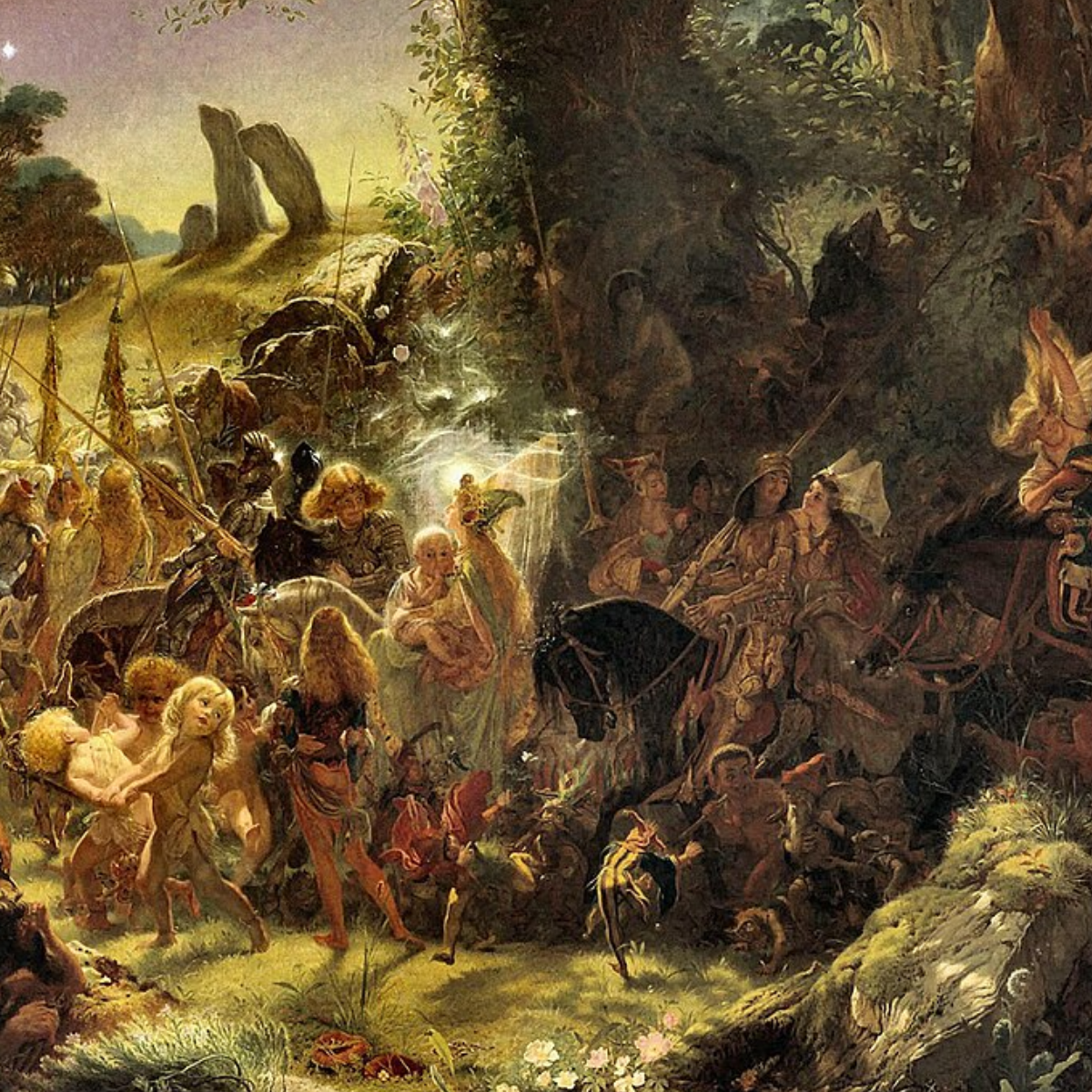
As I’ve mentioned before, Welsh faerie folklore is at the heart of my interest in folklore. In fact, it is what prompted me to embark on the novel I’m writing, as well as my newsletter and blog. I’ve written on many topics related to faeries, and will continue to do so, but I felt like it was time to do a proper overview of the Tylwyth Teg (the Welsh faeries).
If you are new to the blog (welcome!) or missed last month’s post, you can read it here if you’d like. It introduces the Tylwyth Teg and the many names they go by. It also explores Annwn (the Welsh otherworld) and early faerie tradition through a medieval manuscript, the Mabinogion.
This month we’ll continue learning about the Tylwyth Teg, but from a 19th- and early-20th-century perspective. We’ll explore their general characteristics and some of the folklore associated with them as collected by folklorists during that time. So without further ado, let’s dive in!
Origins and Characteristics of the Tylwyth Teg
From a 19th- and early-20th-century standpoint, the Tylwyth Teg seem to be both tangible and otherworldly at the same time. The origins of the Tylwyth Teg or the source for the belief in them appears to be up for debate. Some folklorists saw the faeries as being rooted in history, suggesting that these myths were accounts or traditions from early Welsh history. Others, however, interpreted the faeries as the ghosts or spirits of departed ancestors, or even as demons.
Regardless, I think Elias Owen in his book, Welsh Folk-Lore: A Collection of the Folk-Tales and Legends of North Wales, sums up this dichotomy when he writes: “There is a real and unreal, a mythical and a material aspect to Fairy Folk-Lore.” Indeed there are times when the Tylwyth Teg seem very human-like, and there are other occasions where they definitely behave in an otherworldly fashion.

Descriptions of the Welsh faeries seem to range as well. In Celtic Folklore: Welsh and Manx, John Rhŷs includes some general notes on the Tylwyth Teg as provided by an essay written by Mr. William Jones for a folklore competition in 1880. Jones explains that traditions and beliefs surrounding the Tylwyth Teg varied within Wales. For example, he notes that in certain locations the Welsh faeries were depicted as “a small folk of a thieving nature,” who stole money from farmers. In other locales, the faeries were a little larger and inclined to steal dairy goods and more troubling, unbaptized infants. Changeling legends were common in Wales, where faeries were believed to steal children and leave an unwanted faerie, commonly known as a changeling, in its place.
Yet in other instances the Tylwyth Teg seemed to treat mortals with kindness or modeled human family structure by marrying and having children, even though they were said to be “spiritual and immortal beings.” These faeries were depicted as attractive and lived an aesthetic lifestyle. Jones’ notes describe them in this fashion:
Not only was this last kind [of Tylwyth Teg] far more beautiful and comely than the others, but they were honest and good towards mortals. Their whole nature was replete with joy and fun, nor were they ever beheld hardly, except engaged in some merrymaking or other. They might be seen on bright moonlight nights at it, singing and carolling playfully on the fair meadows and the green slopes, at other times dancing lightly on the tops of the rushes in the valleys. They were also wont to be seen hunting in full force on the backs of their grey horses; for this kind were rich, and kept horses and servants.
This description reminds me of the heroic faeries found in the Irish tradition, the Daoine Sídhe. Heroic faeries were likened to human aristocrats and enjoyed pursuits such as music, dancing, riding, and hunting.
Did the Tylwyth Teg Have Their Own Language?
If you are a fan of The Lord of the Rings by J. R. R. Tolkien, you may already know that Sindarin, one of the Elvish languages of Middle-earth, is based on the Welsh language. Apparently, Welsh was one of Tolkien’s favorite languages. It seems he was fascinated by its sound, spelling, and the duality of an older language that felt “alive.” (I can totally relate!)
As we discussed in last month’s post, Y Tylwyth Teg, the most common name for the Welsh faeries, has quite a few synonyms, including ellyllon, a word with a variety of translations. One possible meaning of ellyllon is “elves.” This got me to thinking—did the Tylwyth Teg have a language of their own (an Elvish, if you will), or did they simply speak Welsh?
I was delighted to learn that the answer was … maybe! In his book, Rhŷs (who was very interested in Celtic and Welsh philology in addition to folklore) addresses this very question. He notes that tales often present the faeries as speaking the same language as the humans. But then he mentions that there were some exceptions to this.
According to Rhŷs, a well-known story of the Welsh faeries having their own language is the tale of Elidorus recorded in the medieval manuscript, Itinerarium Cambriae, by Gerald of Wales. As the story goes, Elidorus, a priest, spent time in the faerie realm during his youth. Elidorus recounts that while he was with the faeries, he learned their language and gives some examples, which he found to be similar to his own language (Welsh). Rhŷs explains though, that Gerald of Wales saw in these faerie words a “similarity to Greek.” Rhŷs acknowledges that while Elidorus’ tale doesn’t answer the question of what the faerie language was, it did stir his curiosity, and he had “begun looking out for stories bearing on it.”
He then shares a few other stories he had come across where faerie language is addressed. In one tale, the language is “not intelligible” to the humans, and in two other stories, the faerie language is “clearly stated that it was neither Welsh nor, probably, English.” Rhŷs offers a potential theory and writes: “Since the fairies are always represented as old-fashioned in their ways, it is quite possible that they were once regarded as talking a more ancient language of the country.”
Lakes Serve as the Entrance to the Realm of the Tylwyth Teg
The realm of the Tylwyth Teg, as presented in folktales and folklore collections, is generally subterranean and has a strong connection with water. Mountain lakes and pools are often described as entrances to the faerie otherworld—beneath the dark water’s surface existed a magical realm. In his book, Owen describes how faerie ladies (as well as faerie cattle) might “emerge from lakes and disappear into lakes.”

In the thesis “Y Tylwyth Teg: An Analysis of a Literary Motif,” Angelika Heike Rüdiger explains that this folk belief of a faerie realm in a pool or lake is prevalent in legends surrounding lake maidens and faerie cattle.
I find lake maiden tales fascinating, and I took more notes on them than was reasonable for this article, so I will save the details of these stories for another post. But to briefly explain, in the Welsh faerie tradition, they are faerie mistress tales in which a faerie marries a human, but there are rules and conditions to be followed. In the meantime, if you’d like to read a legend of this type, I did include one in my post on apple tree folklore.
As for faerie cattle, I explored a few Welsh legends about them when I looked at “cows of abundance”—faerie cows that produce limitless amounts of milk. These tales are similar to lake maiden stories in that certain conditions must be followed; if not, the magical cow will leave and head straight for a lake, as in the Welsh legends of Y Fuwch Frech (The Freckled Cow) and Y Fuwch Gyfeiliorn (The Stray Cow).
In addition to lakes and pools, I also encountered accounts which linked the Tylwyth Teg to mist. Last month we learned about Y Brenin Llwyd (The Grey King), who Owen described as “king of the mist,” a personage which embodied “the spirit of the mist.” As I researched for this post, though, I found several mentions in Rhŷs’ book connecting the faeries to mist. A few different people in the area of the Llŷn Peninsula told Rhŷs of folk beliefs where the Tylwyth Teg appeared with the mist or loved revelling in it, especially in misty mountainous areas. He also includes the following account:
To this I may add the testimony of a lady, for whose veracity I can vouch, to the effect that, when she was a child in Cwm Brwynog, from thirty to forty years ago, she and her brothers and sisters used to be frequently warned by their mother not to go far away from the house when there happened to be thick mist on the ground, lest they should come across the Tylwyth Teg dancing, and be carried away to their abode beneath the lake.

This story links the Tylwyth Teg to both the mist and to the belief of a faerie realm under a lake. It also reminds me of tales of nursery bogies, which parents would sometimes use to frighten their children into safe or good behavior.
The Coblynau (Knockers)
I wanted to give a brief description of a very specific group of Welsh faeries—the Coblynau (Knockers). Owen includes them within the section of his book devoted to the Tylwyth Teg and describes them in this way:
The Coblynau or Knockers were supposed to be a species of Fairies who had their abode in the rocks, and whose province it was to indicate by knocks, and other sounds, the presence of ore in mines.
Miners working in a mine might hear the knocking sounds made by the Coblynau. If they followed in the direction where the knocking came from, they would find the ore. It was said that when the Coblynau stopped knocking, the miners had reached the location of “rich lodes of lead or other metals.”

While researching for this post, I came across a North Wales Wildlife Trust web page with an audio trail for Halkyn Mountain Common. The web page includes audio clips that a hiker might listen to while exploring the region, which was once an area known for lead mining. Audio clip number 6, is a fun listen—Andy Harrop-Smith, a storyteller, gives additional details about the Coblynau.
More Faerie Folklore to Come
When I first outlined this piece, I had wanted to include some specific tale types of the Tylwyth Teg (like the lake maiden tales I mentioned earlier). Because I’m a reader and writer of fiction in addition to being a folklore fan, I find that love folktales. But to keep this post a reasonable length, I shall hang on to my notes and ideas for future articles.
I would like to leave you with a quote about the Welsh faeries I found several years ago in An Encyclopedia of Fairies: Hobgoblins, Brownies, Bogies, and Other Supernatural Creatures by Katharine Briggs:
The Welsh fairies seem to have been rather unusually high-souled. As a rule the most people expected of the good fairies was a general readiness to be helpful, and fairness in their dealings; that is, the return of fairy borrowings, gratitude for kindness done to them, patronage of true love, delight in music and dancing and a general interest in fertility, in neatness, order and beauty.

Even bad fairies did not lie; they only equivocated.
If you’re interested in learning more on the Tylwyth Teg, please see last month’s post, which you can read here if you’d like. It introduces the Tylwyth Teg and explores Annwn (the Welsh otherworld) through a medieval manuscript, the Mabinogion.
As ever, thank you for reading my blog. If you know someone fascinated by faerie folklore, feel free to share this post with them.
Art credit (featured image): The Fairy Raid: Carrying Off a Changeling, Midsummer Eve by Joseph Noel Paton (cropped) via Wikimedia Commons, public domain