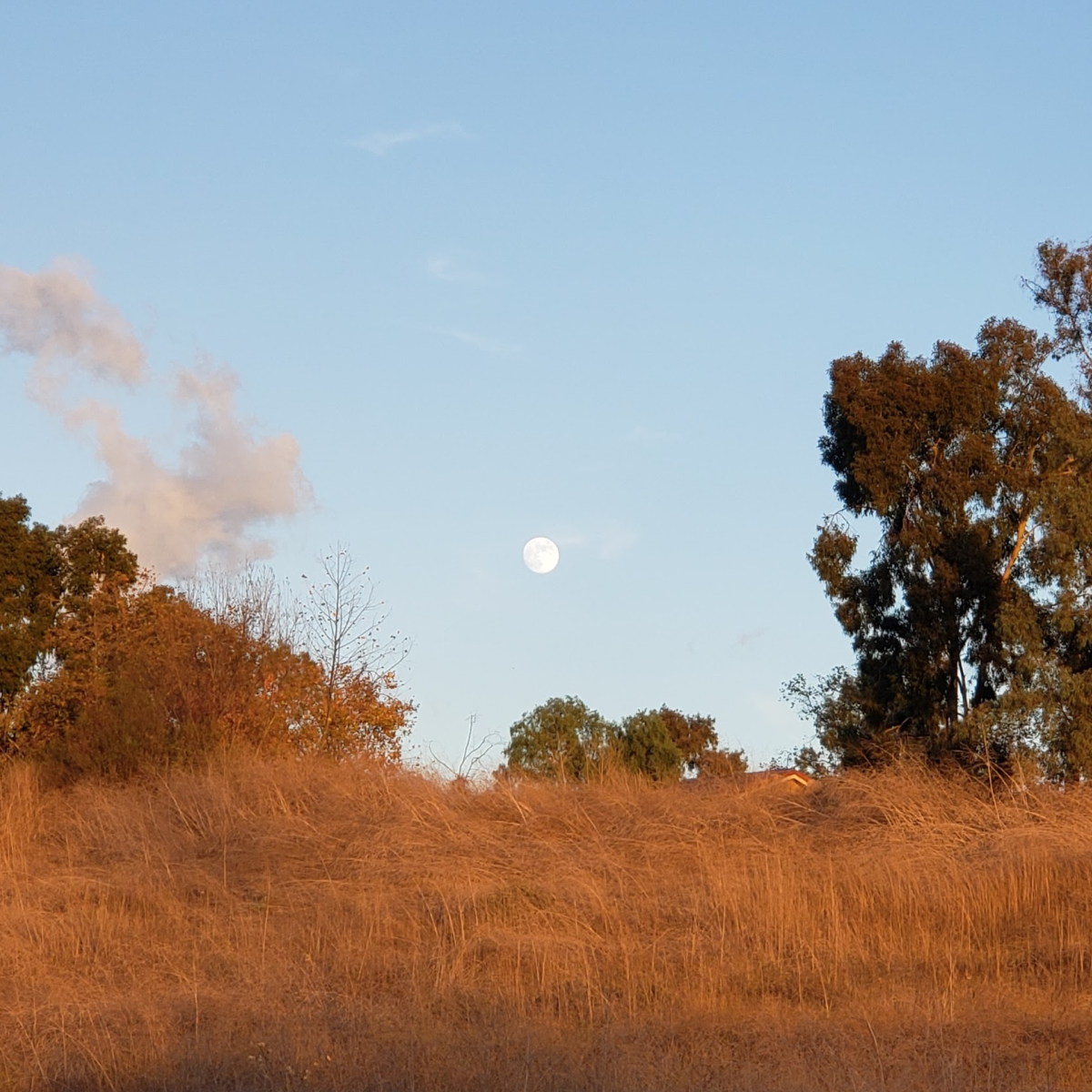
I have always been fascinated by the moon. If I wake in the middle of the night, I often look for it through my window before going back to sleep. I especially love full moons—bright and large in the night sky. Even the moon rising in the afternoon before the sun sets (which I often see on my walks) brings me joy.
So when I came across the legend known as “The Dead Moon” (also called “The Buried Moon”), I was intrigued. At the time, I only had access to a summary of the tale (in Katharine Briggs’ An Encyclopedia of Fairies: Hobgoblins, Brownies, Bogies, and Other Supernatural Creatures), but that was enough to hook me in. I’ve even included reference to it in the folklore-inspired novel I’m currently revising.
Since then, I’ve gathered more background information about the legend, which I’ll share first. Then we’ll explore the legend itself!
“The Dead Moon”: A Legend From North Lincolnshire
“The Dead Moon” was originally documented in “Legends of the Cars,” a series of three articles by Marie Clothilde Balfour, published in Folk-Lore in 1891. Within this series are ten tales, which Balfour collected in North Lincolnshire. More specifically, they are stories and legends from the “Cars,” which today is written as “Carrs.”
In her thesis “Investigating the ‘Legends of the Carrs’: A Study of the Tales as Printed in Folk-Lore in 1891,” Maureen James explains that the Carrs were wetlands close to the River Ancholme. She writes: “Until the mid-17th Century, in the Carrs, like the Fens further south, the flat land to the east and west of the River Ancholme, was flooded for much of the year ….” Once good drainage was established for the area, the land became cultivated. However, the tale of “The Dead Moon” takes place before that drainage occurred, when the Carrs was marshy and boggy—a land where reeds, willows, and alders grew.

I’d be remiss if I didn’t mention that there’s been some criticism regarding Balfour’s collection of tales, including “The Dead Moon.” Doubts regarding the authenticity of the collection have been made over the years. Briggs, who cites Balfour’s articles as a reference and includes summarized versions of many of the stories in her encyclopedia, writes the following in her discussion of “The Dead Moon”:
This is one of a group of stories so unusual that some folklorists have doubted their genuineness. Mrs Balfour, however, published the notes which she took at the time, which established the general accuracy of the tales, though an occasional Scottish word may have strayed in [Balfour was born in Scotland], and there is no doubt from subsequent collection that the Fen area was a unique confine of legends and traditions.
In her thesis, James digs into the authenticity debate of the tales, but notes that:
… despite these criticisms, reputable compilers of story collections have included the Legends in their anthologies; writers for children have produced books based on the stories; storytellers involved in the revival movement have continued to tell the Legends within performances; and artists have used the Legends as inspiration for many projects.
While we cannot know the complete truth, the legends from Balfour’s collection persevere. My interest in “The Dead Moon” stems from its uniqueness—it feels like a combination of legend, myth, folktale, and fairy tale.
“The Dead Moon” Is Also Known as “The Buried Moon”
The original legend of “The Dead Moon” that Balfour collected is actually difficult to read because it is written in a phonetic dialect. But we are fortunate because Joseph Jacobs (the editor of Folk-Lore who included Balfour’s articles in the journal) also incorporated a version of the tale under the title “The Buried Moon” in his own collection, More English Fairy Tales.
In his own notes on the tale, Jacobs explains that his version of the story has been “somewhat abridged and the dialect removed.” For ease of reading, I will quote from Jacobs’ version (“The Buried Moon”) at times and summarize at others.
To briefly set up the tale, Balfour explains in her article that she first heard of “The Dead Moon” from some children who were singing a nursery rhyme. She collected the specific legend, though, from a nine-year-old girl, who “heard it from her ‘gran.’” Balfour writes of the storyteller in this way:
But I think it [the tale] was tinged by her own fancy, which seemed to lean to eerie things, and she certainly revelled in the gruesome descriptions, fairly making my flesh creep with her words and gestures. I have kept not only to the outline of her story, but in great part to her very words, which I think I could not have made more effective even if I had wished to do so.
Sounds a bit spooky! In her thesis, James explains that the stories Balfour collected tended to “reflect aspects of the lives of the tellers.” Specifically, she notes that the teller of “The Dead Moon” was “concerned with the dangers that lurked in the Carrs at night.”
If you’re ready, let’s tread carefully back in time to when the Carrs were still boggy and filled with spirits and the supernatural!
The Moon Is Troubled by “Bogles and Crawling Horrors”
As we learned before, it’s a young girl telling the tale, and she begins by referencing her grandmother and a specific place (the Carrs). This adds some element of believability to the tale, making it feel like a legend:
Long ago, in my grandmother’s time, the Car-land [the Carrs] was all in bogs, great pools of black water, and creeping trickles of green water, and squishy mools which squirted when you stepped on them.

Well, granny used to say how long before her time the Moon herself was once dead and buried in the marshes, and as she used to tell me, I’ll tell you all about it.

The Moon up yonder shone and shone, just as she does now, and when she shone she lighted up the bog-pools, so that one could walk about almost as safe as in the day.

But when she didn’t shine, out came the Things that dwelt in the darkness and went about seeking to do evil and harm; Bogles [goblins] and crawling Horrors, all came out when the Moon didn’t shine.

Well, the Moon heard of this, and being kind and good—as she surely is, shining for us in the night instead of taking her natural rest—she was main troubled. “I’ll see for myself, I will,” said she, “maybe it’s not so bad as folks make out.”

Sure enough, at the month’s end down she stept, wrapped up in a black cloak, and a black hood over her yellow shining hair. Straight she went to the bog edge and looked about her.
I find this personification of the moon as a woman fascinating. In their books, both Jacobs and Briggs refer to the tale as having a mythological aspect. Briggs doesn’t go into details, but states that the story is mythological and not typical of English folk tradition. Jacobs, however, explains that the personified moon is presented as “a beneficent being, the natural enemy of the bogles and other dwellers of the dark.”
But what did the Moon see when she came down to the edge of the bog? And who were some of these “dwellers of the dark?”
The Moon Enters the Bog
I had to go to Balfour’s version of the tale to find out as Jacobs skips over this section of the original text. In her thesis, James explains that Jacobs removed “some of the darker references.” I’m not exactly sure why, but it seems from his preface that maybe Jacobs anticipated children would read the stories in his book.
Summarizing from Balfour’s version:
At the bog’s edge, beyond the darkness lit only by the stars and the subtle shine coming from the Moon’s uncovered feet, lurked a whole host of frightening characters in the endless water. She saw witches riding on their great black cats and the evil eye that “glowered fro’ tha da’arkest corners.” Will o’ the Wykes danced about and “de’ad fo’ak” rose out of the water. Trembling, the Moon drew her cloak around her and kept going deeper into the bog.
Now I feel like I’m reading a folktale! According to Briggs, Will o’ the Wykes is the Norfolk name for Will o’ the Wisp or ignis fatuus (which is Latin for “foolish fire”). (Here’s an interesting article from Scientific American if you’d like to go down that rabbit hole.)
Returning to Jacobs’ version of the tale:
Just as she came near a big black pool her foot slipped and she was nigh tumbling in. She grabbed with both hands at a snag [a tree or branch] near by to steady herself with, but as she touched it, it twined itself round her wrists, like a pair of handcuffs, and gript her so that she couldn’t move. She pulled and twisted and fought, but it was no good. She was fast, and must stay fast.

While trapped, she saved a man lost in the bog who was calling out and crying into the darkness. She couldn’t free herself, but “she twisted and turned, till her black hood fell back off her shining yellow hair, and the beautiful light that came from it drove away the darkness.” Her light scared off “all evil things,” and the man found his way out of the marsh.
The Moon, too, wished to escape her entanglement, but witches, bogles, “Crawling Horrors,” and other evil things crept forward in the darkness:
They came crowding round her, mocking and snatching and beating; shrieking with rage and spite, and swearing and snarling, for they knew her for their old enemy, that drove them back into the corners, and kept them from working their wicked wills.
The witches wanted to poison the Moon for spoiling their spells, and the “Crawling Horrors” wished to smother her. They argued about what punishment to inflict on the Moon, but as dawn approached “the Bogles fetched a strange big stone and rolled it on top of her, to keep her from rising.” Two Will o’ the Wykes were stationed to guard her. “And there lay the poor Moon, dead and buried in the bog, till some one would set her loose; and who’d know where to look for her.”
I noticed that the phrase “dead and buried” appears several times in both Balfour’s and Jacobs’ versions. I feel like it might explain the difference in the titles between the two versions. Balfour seems to lean into the darkness, desiring to capture the teller’s “gruesome descriptions,” as I mentioned earlier. It makes sense, then, that she would choose “The Dead Moon” as the title for the legend. (In her article she implies that she chose the title—it doesn’t seem like it was given to her by the young girl telling the story.)
On the other hand, Jacobs chose to remove some of the darker elements, so changing the title to “The Buried Moon” lightens the overall tone of the tale. And as we shall soon see, there’s hope to be had for the poor Moon.
In Search of the Moon
Days passed, the new moon did not arrive, “the Evil Things were worse than ever,” and folk grew nervous. At this point, people began consulting a wise woman about how to find the missing Moon.
At first the wise woman, who practiced divination by “looking in the brewpot, and in the mirror, and in the Book,” couldn’t tell them what had happened to the Moon. But after more days passed, the man who’d been lost in the bog and helped by the Moon realized that he may know where she was. So he and some other folk returned to the wise woman, who told them:
“Go all of ye, just afore the night gathers, put a stone in your mouth, and take a hazel-twig in your hands, and say never a word till you’re safe home again. Then walk on and fear not, far into the midst of the marsh, till ye find a coffin, a candle, and a cross. Then ye’ll not be far from your Moon; look, and m’appen ye ‘ll find her.”

The next night the local men went out to the bogs, each “with a stone in his mouth, and a hazel-twig in his hand.” And they discovered that the wise woman’s clues were spot-on: the stone covering the Moon resembled a coffin, the snag that had caught her was shaped like a cross, and a “tiddy light flickered” on the snag like a candle. (I believe “tiddy” means “tiny.”)
Knowing they were in the right spot, they knelt and said the Lord’s Prayer to themselves, “first forward, because of the cross, and then backward, to keep off the Bogles.” Then they lifted the stone, freeing the Moon. For a brief moment, they saw her face, but her shining light overwhelmed them. Once they could see again, they saw:
… the full Moon in the sky, bright and beautiful and kind as ever, shining and smiling down at them, and making the bogs and the paths as clear as day, and stealing into the very corners, as though she’d have driven the darkness and the Bogles clean away if she could.
A happy, hopeful, fairy-tale ending! In Balfour’s version, there is an additional paragraph, in which the young storyteller claims that the story is true, and that her “gran” had seen the snag and the stone where the Moon had been buried.
So what do you think? Does the tale feel like a legend, myth, folktale, or fairy tale to you?
As ever, thank you for reading my blog. If you know someone fascinated by folklore, feel free to share this post with them.
Photo credit (featured image): A photo of the moon rising in the afternoon. (I took this photo several years ago on one of my wilderness walks.) Photo by Steph Rae Moran, 2023, personal collection.