Near the tail end of last year, John Rux-Burton, a writer and photographer, sent me a link to a piece he’d written regarding Radnor Forest in Wales. In it, he refers to a few dragon legends. One of the legends describes Radnor Forest as the place where the last dragon in Wales sleeps. This intrigued me, but when I did some research, I couldn’t find too much more than what is written in the post, “The Dragon Of Radnor Forest.”
However, near the end of John’s article, he references a medieval dragon legend. During our correspondence, he mentioned that he was curious if the medieval tale was connected to or had influenced the Radnor Forest legend in some way. This took me down a research dragon hole!
While I haven’t been able to determine for certain if the medieval legend gave rise to the local story of the dragon sleeping in Radnor Forest, I have learned more about the legend itself. Or rather, legends, I should say. It turns out that the medieval legend is actually a pair of connected legends about two dragons, and it’s been a fun puzzle to piece it all together. The dragon legends begin with the tale of “Lludd and Llefelys” and conclude with a story that includes Merlin (of Arthurian legend).
To make good use of my all of my research on the topic, I thought it would be fun to share these dragon legends with you.
A Tale of Three Plagues and Two Dragons: “Lludd and Llefelys”
Before we get to the dragons, I want to briefly set the scene. The tale of “Lludd and Llefelys” layers folklore and myth within a pseudo-historical narrative. The story first appeared in a medieval, Welsh translation of the History of the Kings of Britain by Geoffrey of Monmouth. Later it was included in two other medieval texts: the White Book of Rhydderch and the Red Book of Hergest. Additionally, it’s part of the collection of tales that make up the Mabinogion. In the introduction to her translation of the Mabinogion, Sioned Davies summarizes the tale in this way:
Lludd, who according to tradition was king of Britain shortly before Julius Caesar’s invasion, overcomes three plagues that threaten the land, with the help of his brother Llefelys, king of France. All three plagues have parallels elsewhere in Welsh literature, and can be seen as variants on the theme of the historical invaders who threatened the sovereignty of the Island of Britain.
The tale explores not only the arrival and eventual defeat of these three plagues, but also the relationship between the two kings and how they navigate the situation.

After Lludd and Llefelys are introduced at the beginning of the tale, the three plagues descend on Britain. The first is a group of people known as the Coraniaid, who can hear every conversation on the island, “provided the wind carried it.” The final plague is “a powerful magician who can lull the court to sleep,” then steals their food and provisions.
However, it is the second plague which occurs between the Coraniaid and the magician that we are most interested in for this post.
And that plague begins with a dragon’s scream.
The Second Plague: A Terrifying Dragon Scream
Every year, Lludd and the people of Britain hear a terrible scream, but they don’t know what it is or what it signifies. Here’s Davies’ translation of the description of the second plague in the Mabinogion:
The second plague was a scream that was heard every May eve above every hearth in the Island of Britain. It pierced people’s hearts and terrified them so much that men lost their colour and their strength, and women miscarried, and young men and maidens lost their senses, and all animals and trees and the earth and the waters were left barren.
What a chilling and awful scream! The fact that it occurs on May eve, though, is a clue that the scream is potentially not of this world. In a note, Davies explains that in Wales (as in Ireland), the Celtic year had two seasons—winter began with “Calan Gaeaf (the first day of winter)” and summer began with “Calan Mai (the first day of the summer, or May).” These two days of the year were considered to be liminal periods, when the “boundaries between the natural and the supernatural world would be removed.”
But even though the scream occurs every May eve, Lludd doesn’t know what to make of it or how to handle the other plagues, so he travels to see Llefelys and seek his counsel. Llefelys is known to be wise, and he explains to Lludd that the source of the scream is a dragon. The dragon is engaged in battle with another dragon, which is trying to “overthrow it.”
As Llefelys describes the situation to Lludd, the dragons are also presented as symbolic. He refers to the attacking dragon as “a dragon of another foreign people” and the dragon defending its ground and emitting the scream as “your dragon,” by which I believe he means that the dragon represents Britain.
But the question remains—how does a king set about to conquer two dragons in order to end this second plague? Not to worry, Llefelys has it all figured out.
Rather than try to destroy the dragons, Llefelys advises Lludd to capture and bury the dragons, and he gives very explicit instructions on how to accomplish this. So Lludd, bursting with the knowledge of how to defeat the dragons (as well as the other two plagues), returns home to put Llefelys’ suggestions to the test.
How to Catch Two Dragons
In order to catch the dragons, Lludd first measures Britain (its length and width) in order to find the precise center of the island, which turns out to be in Oxford. If you look at a map, it’s clear that Oxford is not the physical center of Britain, and Davies acknowledges that it’s uncertain why it is named as such. Regardless, at that location, a hole is dug and “a vat of the best mead that can be made” is placed in the hole. A “sheet of brocaded silk” is laid over the vat of mead. Then Lludd spends the night keeping a watchful eye for the dragons.

The dragons come that night, fiercely fighting each other up in the air. Llefelys had explained to Lludd, that when the dragons grew weary from combat, they would “fall onto the sheet in the shape of two little pigs, and make the sheet sink down with them, and drag it to the bottom of the vat, and they will drink all the mead, and after that they will sleep.” Lludd waits and watches until the dragons (in their pig shape) consume the mead and fall asleep. Then he wraps them up in the sheet and places them in a chest made of stone.
Lludd takes the stone chest and buries it at what he deems is the safest location in Eryri (Snowdonia)—at a hill-fort known from that point on as Dinas Emrys. The final sentence of this portion of the tale in Davies’ translation reads: “And so ended the tempestuous scream that was in the land.” Indeed, Lludd had rid Britain of the plague of the scream. But we must remember, the dragons are only but asleep.
Again, as I’m focusing on the dragons, I will just quickly let you know how Lludd defeats the other two plagues. The Coraniaid (the people with the exceptional hearing) meet with an untimely end: Lludd essentially poisons them with an insect and water recipe given to him by Llefelys.
As for the magician, he sneaks in during one of Lludd’s courtly feasts with a hamper (which functions much like Mary Poppins’ magical carpet bag) and fills it with food and drink. Lludd is positively amazed, but he regains his senses quickly and challenges the magician to a fight. Lludd wins the fight, but the magician asks for mercy and pledges to return what he’s taken, which Lludd agrees to.
While the tale of “Lludd and Llefelys” ends here, the legend of the two dragons does not. Their story picks up again in another medieval text and includes Merlin of Arthurian legend!
Merlin, Vortigern, and Two Sleeping Dragons
This second legend of the dragons is chronicled in the History of the Britons, which is attributed to Nennius. It is later found in Geoffrey of Monmouth’s History of the Kings of Britain. In Nennius’ version, Vortigern, a king of Britain, learns of the dragons from a fatherless boy named Ambrosius (Emrys in Welsh). I came across a note in Davies’ translation of the Mabinogion in which she explains that in Geoffrey of Monmouth’s version, he “identifies the wonder-child Ambrosius with Merlin, who becomes an integral part of the Arthurian legend.”
As a quick prologue, Nennius presents Vortigern as a terrible king and person. By the time we get to the dragons, he has received the Saxons as friends, relinquished Kent for the daughter of a Saxon chief, and then “as if desirous of adding to the evils he had already occasioned, married his own daughter, by whom he had a son.” I’ll be honest, Nennius doesn’t really hold back.
While researching, I found a summary of this second legend in Lady Charlotte Guest’s translation of the Mabinogion. I compared it to a translation of Nennius’ History of the Britons. Guest’s summary matches it and is fairly lively and succinct, so I will quote from it. Just to be clear, she uses the name Merlin for Ambrosius. Without further ado, let’s pick up where we left off—with a king and two buried, sleeping dragons.
Merlin Reveals the Dragons to Vortigern
Guest begins the tale in the following way:
Vortigern being forced to retire from his kingdom, in consequence of his various delinquencies, took refuge in Snowdon [Eryri]; and finding Dinas Emrys an eligible spot, commenced building a tower [a citadel] there. But, to his great dismay, he found that whatever he built in the daytime, always fell down in the succeeding night.
Vortigern consults his magicians (wise men) regarding this mystery. They explain that he must find a child without a father, and sprinkle the ground where the citadel will be built with the child’s blood, or he will never succeed at building the citadel.
On learning this, Vortigern sends out messengers to search for such a child. They eventually find Merlin, whose mother explains that she doesn’t know how he was conceived as she hadn’t had intercourse with a man and claims that Merlin doesn’t have a mortal father. The messengers then bring Merlin to Vortigern. Before Vortigern can put Merlin to death, the boy speaks up to defend himself. Guest writes:
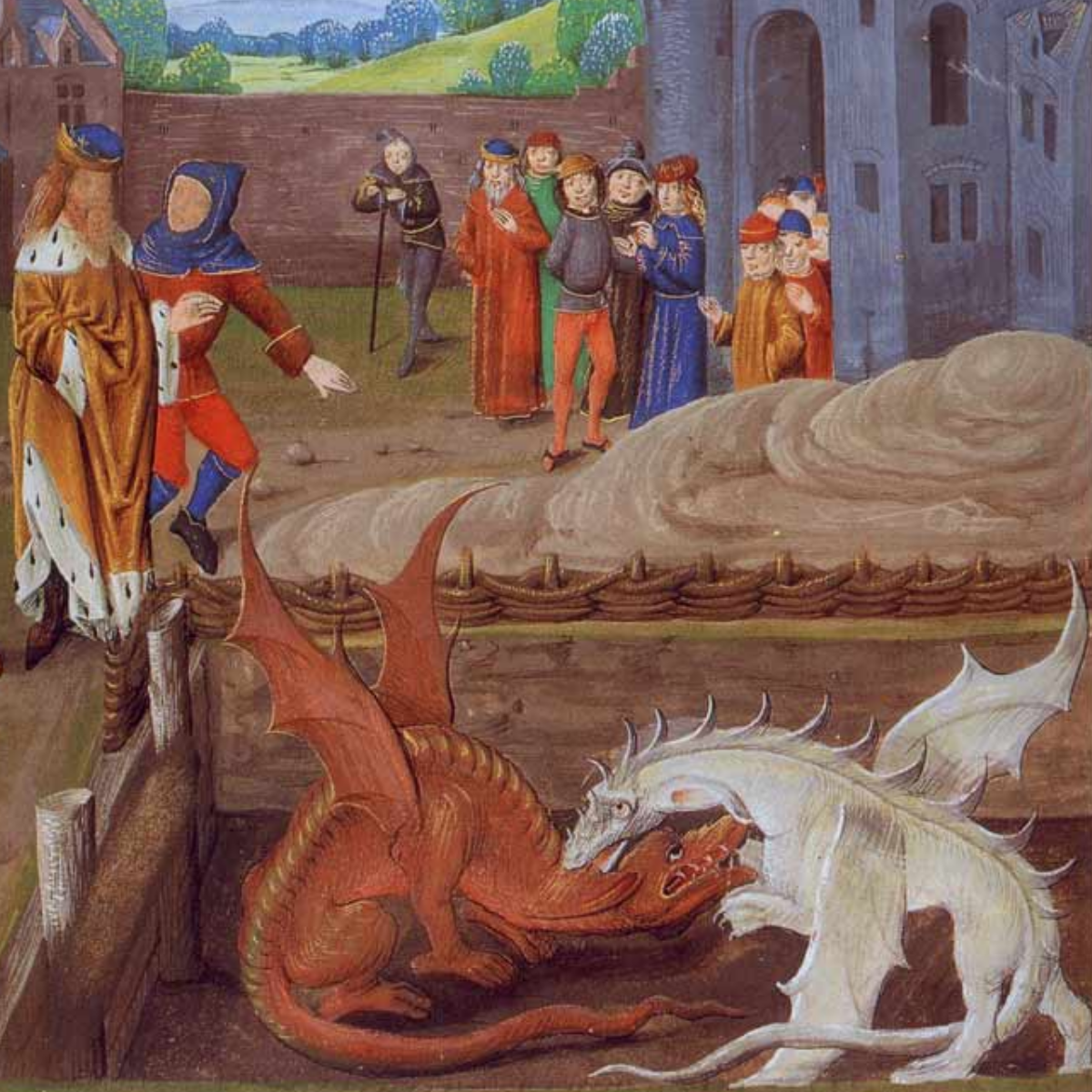
But the boy exposed the ignorance and imposture of the magicians, and caused the ground to be dug at the foundation of the building, where they found two sleeping dragons, one white and the other red. These dragons awaking from their sleep commenced a furious conflict. The white one at first had the advantage of the red, but at last the red dragon prevailed, and expelled his opponent. Merlin then informed them that the red was the British dragon, and the white one that of the invading Saxons.

As a side note, at this point in the tale Guest explains that in Geoffrey of Monmouth’s version, this is where “Merlin uttered the celebrated prophecy concerning the fate of Britain” and “declared his name to be Merlin Ambrosius.”
After exposing the dragons and interpreting their significance, Merlin claims that he will remain at the citadel, but that Vortigern should look for a new location to build his fortress. Guest concludes the tale in this way:
Vortigern departing thence to seek some other place of refuge, bestowed that citadel upon the wonderful child [Merlin], … and after whom the spot was called Dinas Emrys.
Recalling that Dinas Emrys is the location where Lludd buried the sleeping dragons, we can see that the two dragon legends are connected through the landscape. Davies points out, though, that the use of the place name of Dinas Emrys in “Lludd and Llefelys” is a little bit of the cart before the horse. She notes that “the naming here is anachronistic, for Emrys [the Welsh name for Ambrosius/Merlin] … was only linked with the place later, after he had disclosed the whereabouts of the dragons.”
Additionally, these two legends are important beyond their scope as stories. They contribute to the history and lore of the red dragon as a Welsh symbol. Even today, the red dragon appears on the Welsh flag.
Are These Legends Linked to the Sleeping Dragon of Radnor Forest?
To come full circle with respect to John’s curiosity as to whether the legend of the sleeping dragon of Radnor Forest might be connected to the two legends we just explored, I’m happy to report that I did discover a link. So while I can’t say for certain that the medieval legends gave rise to the Radnor Forest legend, I can see that there might have been some type of connection.
At the end of Vortigern and Merlin’s story in Nennius’ History of the Britons, when Vortigern leaves Merlin at Dinas Emrys and seeks a new location to build a fortress, Nennius states that Vortigern arrives in “the region named Gueneri, where he built a city which … was called Cair Guorthegirn.” A footnote attached to “Cair Guorthegirn” explains that there has been some debate between antiquarians about where this city was. Some thought it to be in Monmouthshire or perhaps Caermarthen, but others placed it in Radnorshire, where Radnor Forest is.
When myth and legend are blended with history, it is difficult to know all of the facts. But tales shared through oral storytelling and manuscripts are often passed between people, generations, and cultures. As a result, similar types of stories can be found in different geographical locations.
As ever, thank you for reading my blog. Need more dragon folklore? I’ve also written about British and Celtic dragons and explored the tale of “The Celtic Dragon Myth.” 🙂
Art credit (featured image): Illumination of a 15th-century manuscript of Historia Regum Britanniae (History of the Kings of Britain by Geoffrey of Monmouth) showing Vortigern and Ambrosius watching the fight between two dragons (cropped) by Master of Edward IV (manuscript illuminator) via Wikimedia Commons, public domain