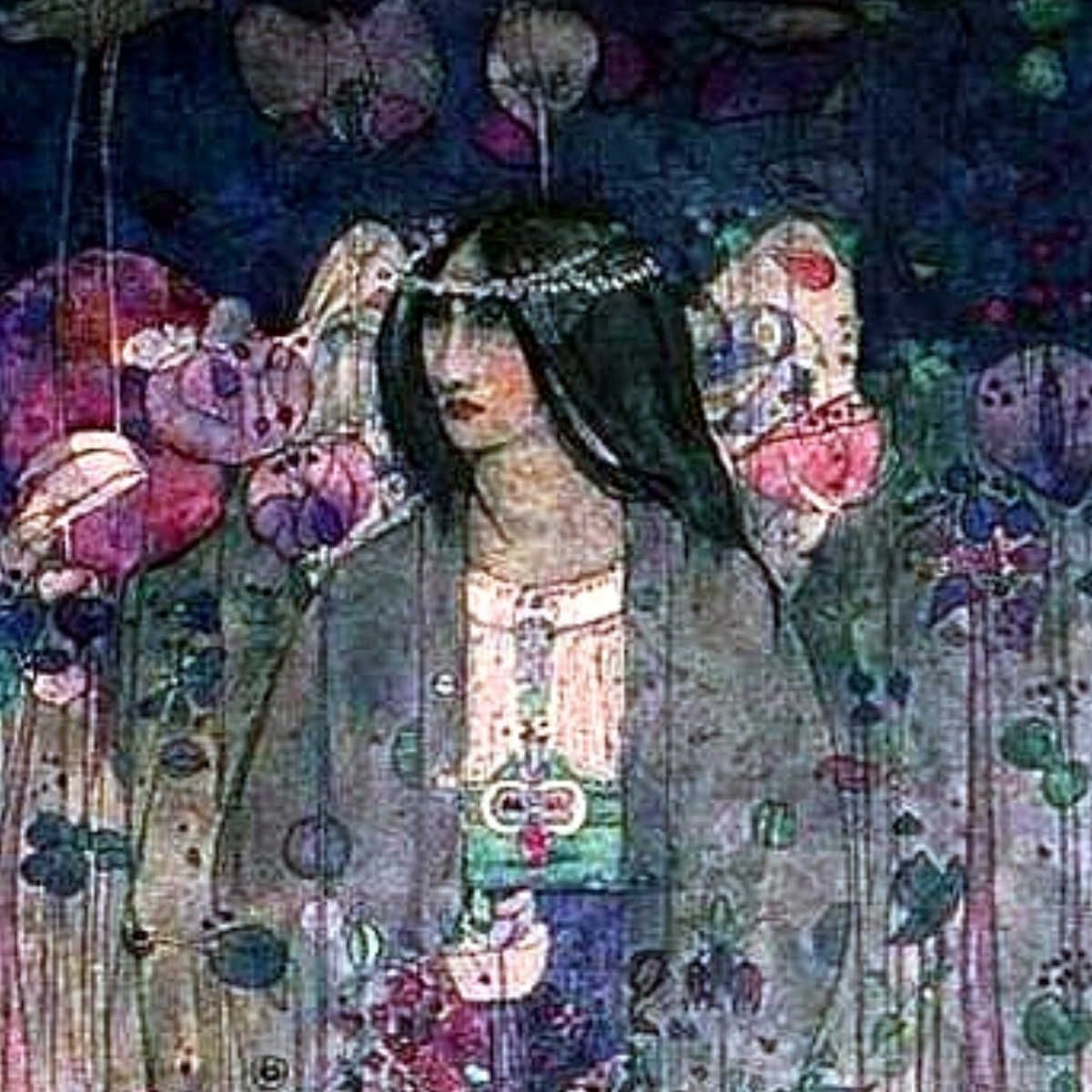
Welsh faerie folklore captivates me. It serves as the foundation for both my newsletter and the novel I’m working on. I’ve written about many different aspects of Welsh faerie lore, but I haven’t really given an overview of the Tylwyth Teg (the Welsh faeries) yet.
So I thought that this month, we’d begin a two-part series to learn about the Tylwyth Teg. We’ll first look at some of the names they go by (there’s more than one!). Then we’ll explore Annwn, which is the realm of the Tylwyth Teg. This month’s post will be a bit linguistic in nature, and the tales will come from the Mabinogion.
Next month, we’ll look at the Tylwyth Teg from a 19th- and early-20th-century perspective in order to learn about some general characteristics and folklore as collected by folklorists during that time period. Hopefully, what we discuss this month will serve as helpful background information in order to better appreciate next month’s material.
Y Tylwyth Teg (and Bendith y Mamau): The Welsh Faeries
By and large, the most common name for the Welsh faeries is Y Tylwyth Teg, which has the meaning of “The Fair Family” or “The Fair Tribe.” In this use, “fair” is synonymous with “beautiful” or “pleasant.” In Welsh Folk-Lore: A Collection of the Folk-Tales and Legends of North Wales, Elias Owen explains that this is because the Tylwyth Teg “are spoken of as a people, and not as myths or goblins, and they are said to be a fair or handsome race.”
In some parts of Wales the expression Bendith y Mamau (“The Mothers’ Blessing” or “Blessing of the Mothers”) is used to refer to the faeries instead. While it is considered to be a synonym for Tylwyth Teg, there seems to be debate on what this expression is referencing. But several sources I looked at did suggest that this name was used in order to keep the faeries appeased.
Indeed both Tylwyth Teg and Bendith y Mamau are polite and amiable names. In the thesis “Y Tylwyth Teg: An Analysis of a Literary Motif,” Angelika Heike Rüdiger offers us a reason why folks used these type of names when referring to the faeries: “The choice of appeasing names suggests that they [faeries] were believed to be powerful and were feared.” It seems that it was viewed as safer to call them by a gentle name rather than stoke their ire by referring to them using a name that described their true nature.

Other Names for the Welsh Faeries: Ellyllon and Plant Annwn
I came across several more names for the Welsh faeries, but two in particular stood out to me because they lend interesting insights into Welsh faerie folklore. One such name is ellyllon. The word “ellyllon” is intriguing because it seems to have a wide variety of translations. While Owen states that ellyllon is a name given to the faeries, he describes the word to mean “elves,” “demons,” or “goblins.”
Rüdiger’s thesis also explores the ellyllon and how the word is often translated differently. In addition to the meanings given by Owen, she also mentions that ellyllon could be rendered as “sprites” or “ghosts,” depending on the translator. This variety of associations has given rise to the question of whether the Tylwyth Teg and the ellyllon are the same or are simply related creatures. Per Rüdiger’s thesis, it doesn’t seem as if there’s a definite answer, but it does suggest that the word “ellyllon” isn’t clear-cut, much like the faeries themselves. They could be seen as supernatural, ghostly, or evil in nature.
The other name for the Welsh faeries that interested me is Plant Annwn (“Children of Annwn”). Again, Plant Annwn is considered to be a synonym for Tylwyth Teg, but in this case, the term isn’t so much describing the faeries themselves, but is noting where the faeries live—in Annwn. We’ll look more at where and what Annwn is in the next section.
Out of curiosity, I looked up all of these names and terms in Geiriadur Prifysgol Cymru (A Dictionary of the Welsh Language), which is a historical dictionary of Welsh, much like the Oxford English Dictionary. From a written language standpoint, Annwn and ellyllon are the oldest of the group—they first appear in writing during the 12th and 14th centuries, respectively. Next comes Tylwyth Teg in the 15th century and Bendith y Mamau in 1587. I was a little surprised to find that Plant Annwn was first mentioned in writing much later—in 1703.
The fact that Annwn and ellyllon appear in texts long before Tylwyth Teg, Bendith y Mamau, and Plant Annwn intrigues me. Rüdiger offers some perspective in the following way: she explains that “fairy traditions were present in Wales prior to the first appearance of ‘Y Tylwyth Teg’ in writing.” She notes that some medieval texts contain stories of Welsh faeries even though the writings may not include the expression “Y Tylwyth Teg” or contain characters that are explicitly named as faeries. So I thought we’d look at the Mabinogion (my favorite medieval text!) for some examples of this early faerie tradition, starting with Annwn.
What is Annwn and Who Are Its Kings?
According to Geiriadur Prifysgol Cymru, the word Annwn (and its older form, Annwfn) is defined as “underworld, netherworld, other world, Fairyland.” But Rüdiger explains that “the etymology [of Annwn] is difficult” and that some translators prefer “not-world” or “very deep.” Myself, I like to think of Annwn as the Welsh otherworld. From my research, this appears to be a contemporary usage.
In the Mabinogion, Annwn is presented as a beautiful, courtly realm separate from the human world, but accessible from specific locations. Rüdiger cites Patrick Sims-Williams and explains that Sims-Williams interprets Annwn to have been a single kingdom with a high king, which was divided into sub-kingdoms with sub-kings. This would have been similar to Welsh medieval political structure. Sims-Williams points to “The First Branch of the Mabinogi” (a tale in the Mabinogion) as evidence of this.
Curious, I searched through the Mabinogion, as translated by Sioned Davies, and I saw what Sims-Williams meant. In this tale, Pwyll (Prince of Dyfed) meets Arawn (King of Annwn/Annwfn) Here is Davies’ translation:
‘Lord,’ said Pwyll, “good day to you. And which land do you come from?’

‘From Annwfn,’ he replied. ‘I am Arawn, king of Annwfn.’

‘Lord,’ said Pwyll, ‘how shall I win your friendship?’

‘This is how,’ he replied. ‘A man whose territory is next to mine is forever fighting me. He is Hafgan, a king from Annwfn. By ridding me of that oppression—and you can do that easily—you will win my friendship.’
In the text, Arawn is self-described as “king of Annwfn” and refers to Hafgan as “a king from Annwfn.” Sims-Williams notes that this reveals Arawn to be the high king and Hafgan to be a sub-king.
Additionally, both Arawn and Hafgan are considered to be otherworldly with supernatural abilities. In “The First Branch of the Mabinogi,” Arawn alters his own shape as well as Pwyll’s. He tells Pwyll:
‘… What I shall do is to put you in my place in Annwfn, … and give you my face and form so that no chamberlain nor officer nor any other person who has ever served me shall know that you are not me. …’
Arawn also instructs Pwyll to kill Hafgan stating, “… ‘and you must give him only one blow—he will not survive it. …’” In a note to the text, Davies explains that “striking a monster twice is a common international motif—were the hero to strike a second time, then the monster [in this case Hafgan, a supernatural character] would revive.”
Both Arawn and Hafgan are otherworldly kings that rule in Annwn, yet neither one is considered to be the king of the Welsh faeries. You may be wondering then, who is the king of the Tylwyth Teg? There is a third king mentioned in the Mabinogion: Gwyn ap Nudd. Rüdiger notes that in the tale “How Culhwch Won Olwen,” “Gwyn ap Nudd rules over the denizens of Annwn,” who are otherworldly and “must be closely guarded by Gwyn and kept away from the world of man, for otherwise they will destroy it.”

While the Tylwyth Teg are not mentioned directly in the Mabinogion, Rüdiger explains in a footnote that they are linked to Gwyn ap Nudd through a manuscript called Buchedd Collen:
Evidence that Annwn is the abode of the fairies is connected with the character Gwyn ap Nudd, for Buchedd Collen with the first manuscript version dating to 1536 refers to Gwyn ap Nudd as ‘Brenin Annwn’ (‘King of Annwn’) and in a version of Buchedd Collen published in Y Greal as ‘[b]renin Anwn a’r tylwyth têg’ (‘King of Annwn and the fairies’).
Now that we’ve established that Annwn is a faerie realm and learned about its otherworldly rulers, let’s look at some of the other supernatural beings that show up in the Mabinogion.
Otherworldly Beings in the Mabinogion
The Mabinogion does not always call out faeries and supernatural creatures directly, but their behavior and the narrative motifs presented in the text clue us in to their true nature.
Over the years that I’ve been writing this newsletter, I’ve covered several otherworldly beings from the Mabinogion. In fact, as I made a list of potential characters to present here, I was surprised that I’d already written about most of those on my list. So aside from one, I will simply give a brief description and then link to my previous post on the topic (in case you’re interested in learning more).
I’ll begin with a character that I have not yet covered, though: Llwyd ap Cilcoed. Llwyd ap Cilcoed appears in “The Third Branch of the Mabinogi,” and Rüdiger describes his otherworldly behavior in the tale:
To begin with, Llwyd ap Cilcoed changes the land by means of a magical mist; he takes people after enticing them into his battlements with an enchanted white boar: white is a magical colour typical of otherworldly animals; Llwyd’s people destroy the crop in the shape of mice.
As a side note, I looked at Davies’ translation of the tale, and “Llwyd’s people” who were transformed to mice include: his retinue, the ladies of the court, and his wife (who was pregnant!). The destruction of crops by faeries is a common folklore motif. Also, white animals are often portrayed as otherworldly or belonging to the faeries in folktales. Because of Llwyd ap Cilcoed’s ability to control the mist, Rüdiger links him with Y Brenin Llwyd (“The Grey King”). In his book, Elias Owen also writes of Y Brenin Llwyd and describes him in this way:
In Carmarthenshire the spirit of the mist is represented … as a hoary headed old man, who seats himself on the hill sides, just where the clouds appear to touch them, and he is called Y Brenhin Llwyd, or The Grey King. I know not what functions this venerable personage, or king of the mist, performed, unless it were, that he directed the mist’s journey through the air.
Rüdiger suggests that due to his actions Llwyd ap Cilcoed might also be considered to be a faerie king or otherworldly ruler in Annwn. But in Celtic Folklore: Welsh and Manx, John Rhŷs offers another interpretation. He likens Llwyd ap Cilcoed to the Irish Liath, son of Celtchar, of Cualu. He notes that both “Llwyd” and “Liath” mean “grey,” and he writes that Liath “is described as the comeliest youth of noble rank among the fairies of Erin.” Rhŷs doesn’t quite name Llwyd ap Cilcoed as a faerie, but he does call him “a great magician.”

In fact, Rhŷs makes note of something I find interesting: he observes that often in the Mabinogion, “the greatest magicians function as kings” and that there are some members of “kingly families whose story shows them playing the role of magicians.” He then lists characters he might include in these categories. He describes Arawn and Llwyd ap Cilcoed, who we’ve already discussed. But he also mentions Math and Gwydion (who created the maiden Blodeuwedd from flowers, then later transformed her into an owl) and Rhiannon (a Celtic horse-goddess, who is linked to magical birds that can transfix the listener with their birdsong).
In addition to magicians and otherworldly beings, there are also supernatural creatures who make appearances in the Mabinogion. Two of my favorites are the Cŵn Annwn (the “Hounds of Annwn,” Arawn’s supernatural hunting dogs, which have white fur and red ears) and the afanc (typically a Welsh river monster, but in the Mabinogion he lives in a cave and kills all who come near with a poisoned spear).
I hope you enjoyed this introduction to the Tylwyth Teg and Annwn! Next month we’ll continue learning about the Tylwyth Teg from a 19th- and early-20th-century perspective and explore some of the folklore associated with them.
As ever, thank you for reading my blog. If you know someone fascinated by faerie folklore, feel free to share this post with them.
Art credit (featured image): In Fairyland by Charles Rennie Mackintosh via Wikimedia Commons, public domain