Before we learn about some of our readers’ fun winter traditions, I wanted to touch on the concept of tradition within the scope of folklore. The word “tradition” comes from multiple origins. According to the Merriam-Webster.com Dictionary, it stems from both Middle French and Latin. From Latin, it derived the meaning: “action of handing over.” While the Merriam-Webster.com Dictionary offers several definitions for “tradition,” the two that most resonate with me are:
the handing down of information, beliefs, and customs by word of mouth or by example from one generation to another without written instruction
and
an inherited, established, or customary pattern of thought, action, or behavior
But then I wondered, how would a folklorist define tradition? When I had researched the definition of “folklore” for an earlier post, I soon discovered that were as many definitions of “folklore” as there were folklorists. 🙂 So I had an inkling that defining and understanding “tradition” would not be straightforward either.
Tradition is an Evolving Concept
I searched through various books and journal articles, and I found an informative article that traces the concept of tradition as it relates to folklore from the late nineteenth century to the millennium. In “The Meanings of Tradition: An Introduction,” Simon J. Bronner explains that tradition and folklore have been linked since shortly after the term “folklore” originated in Britain.
He writes that in the late nineteenth century, Edwin Sidney Hartland (a member of the Folklore Society, who served as its president in 1899) described “the professional pursuit of folklore as first the ‘study of tradition’ and then the ‘science of tradition.’” Additionally, Bronner includes a quote from Hartland, which describes the concept of tradition as both the “mode of preservation and communication, as well as to the things thus preserved and communicated.”
But in the twentieth century, the study of folklore started being viewed as contemporaneous and linked to individuals, not just focused on the past and on groups. Bronner explains how in that era folklore began to be “spread by technology such as telephones and books as well as by word of mouth.” He cites Joseph Jacobs (an Australian-born, English folklore scholar) as influential in this perspective. Bronner writes:
Tradition, he [Joseph Jacobs] implied, was chosen as well as followed; it was created anew as well as inherited from yore.
I found that quote fascinating, especially in light of our readers’ winter traditions that we will learn about shortly. I like the idea of a more inclusive concept of tradition—that it can encompass both past and present, as well as group and individual.
Industrialization also ignited debates on how the meaning of tradition was being affected by changes in society. And discussions continued as to whether folklore could include studying present-day folk and traditions. But in the 1960-70s, the entire idea of linking tradition with folklore studies began to be considered by some as worrisome. Bronner notes:
Leach [MacEdward Leach, an American folklorist] foretold the rethinking of tradition as the emblem of folklore. In the midst of the dramatic rise of mass media, mass culture, and mass communication emphasizing novelty and uniformity, he observed, tradition came under suspicion.
Bronner describes how some folklorists felt that folk studies bound to tradition would keep them from studying mass culture. Others felt frustrated (in this new, modern era) that tradition still looked primarily backward, enforcing “respect for the establishment and duty to follow precedent.”
And with the turn of the millennium in the year 2000, tradition found itself as a point of discussion yet again. Our world now exists in the digital age with global reach. Bronner explains that this has allowed for traditions to cross borders. What effect this will have on tradition “as a symbol for culture” is part of the discussion.
Before reading Bronner’s article I hadn’t fully realized how much the idea of tradition had been reflected on by folklorists. Similar to how the definition of folklore varies depending on the era and the folklorist defining it, so too does the interpretation of the concept of tradition.
Now let’s enjoy learning about some of our readers’ winter traditions!
Readers’ Favorite Winter Traditions
Thank you to all of the readers who contributed their traditions in response to my request last month. Their traditions were so fun to read and learn about! I have included them here as they were sent to me. Aside from some very light edits to punctuation and spelling, they are written in the reader’s own words.
Rebecca-Anne From Australia
“Mum and I started our own custom—during the year, we find old books, which we then tuck away in secret. At Christmas we wrap them all in fabric and open them. We love the same kinds of books, so they’re really a present from ourselves to ourselves. 😆”
Joy
“As a child, we would walk through the neighborhood singing Christmas carols. The kids would be running up to the doors to ring the bells, and the whole chorus assembly made their way to the next section of block. After another song was sung, most of the neighbors would come out of their house to join the group, and this went on until the whole neighborhood was singing together. At the end of the string of homes was a cul-de-sac where the families shared loads of Christmas goodies, hot chocolate, and laughter. I looked forward to it every year, anxiously waiting for them to reach our house so we could join the singing and door dinging.”
Brian From California (US) Shares a Tradition From the Czech Republic
“I had a coworker from the Czech Republic that once told me about an interesting winter tradition his family had. His family would go to the fish market and buy a Christmas carp. They would bring the carp home, then fill up their bathtub with water, and then put the carp in there. It would swim around in there for two days before Christmas, and then they would eat the carp for Christmas dinner. I thought that was an interesting tradition!”
Marianne From Irvine (US) Shares Some Traditions From Sweden and Ireland
“Firstly food—every year when we go to Sweden we make sweet treats from scratch: marzipan, chocolate covered caramel sweets, and gingerbread cookies. I make trifle for dessert, an Irish family tradition. It’s made with layers beginning with tinned fruit cocktail in jelly, then sponge cake, and a layer of custard and whipped cream on top. Then another tradition from home is watching a short animation, The Snowman, that’s accompanied by a song called “Walking in the Air,” sung by Aled Jones (Welsh) [originally performed by Peter Auty in the film]. I’ve watched it at Christmas every year since I was young, and it still makes me cry.”
Steph (and her mom, Karon) From the US
I wanted to get in on the fun and share some of our family winter traditions as well. I called my mom, because I didn’t know all the details. So this is a joint response.
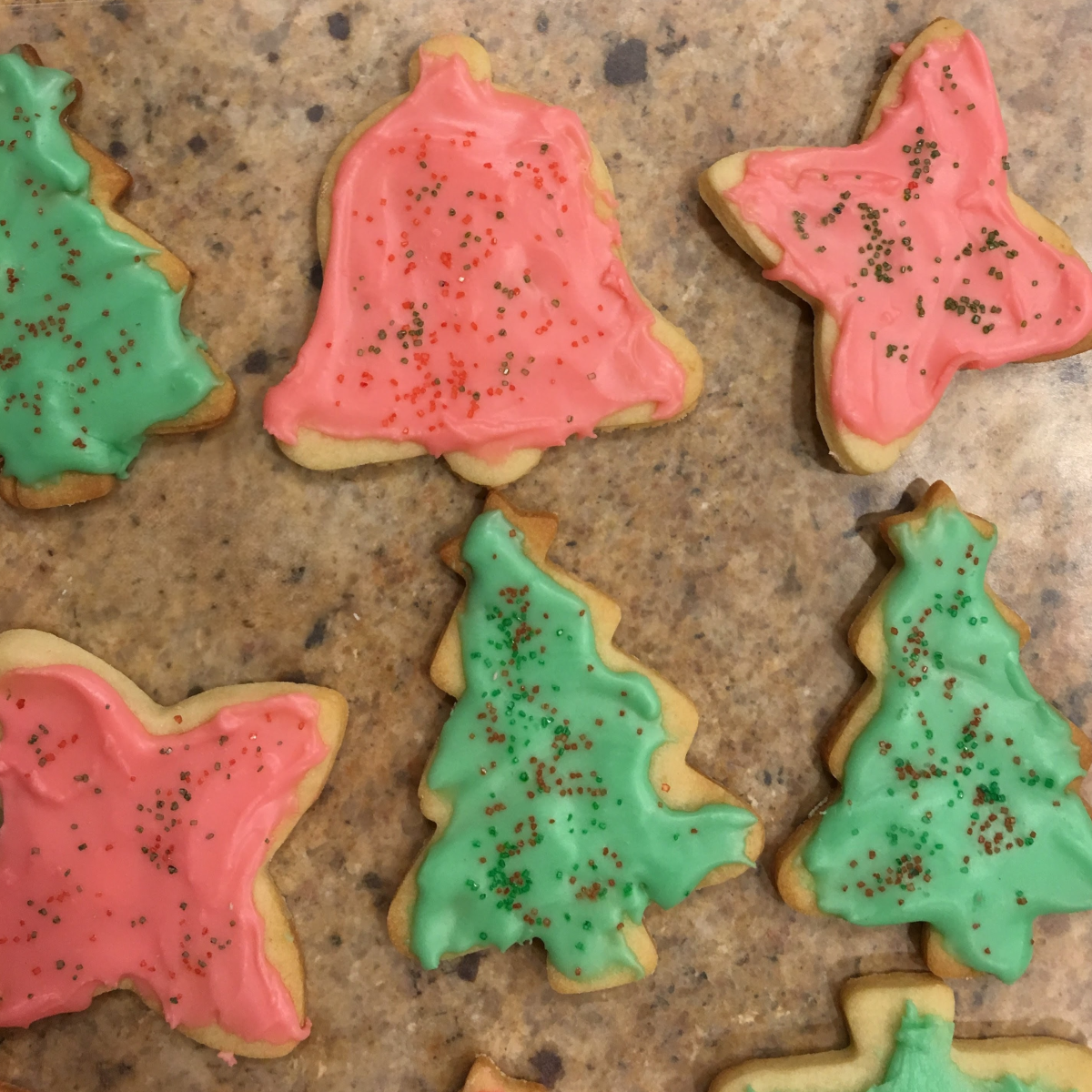
Our most steadfast winter tradition is the baking and decorating of holiday sugar cookies. It began with my grandmother, who at some point bought a box of cookie cutters. Because the cookie recipe we use is printed on stiff cardboard, my mom is pretty sure that the recipe came from that box of cookie cutters.
It turned out to be a pretty tasty recipe, and later on, my mom took possession of both the cookie cutters and the recipe. Growing up, my brother and I (and sometimes family friends as well) would help my mom to roll out the dough. Then we’d cut, bake, and decorate the cookies. When I was in college, I asked my mom for a copy of the recipe, and I bought some cookie cutters so that I could make them as well.
She’s now given me some of the original cutters, plus other ones that she’s accumulated over the years, and I’ve made them with my own children. We make them every few years (they are quite a labor of love).


My mom also reminded me of another tradition that our family practiced—the kids were permitted to open one package on Christmas Eve, but the rest were saved for Christmas Day.
I hope you enjoyed exploring the concept of tradition from a folklore standpoint, as well as learning about our readers’ very own winter traditions. Thanks again to the readers who sent in their traditions!
Behind the Scenes: Writing-Related Wins of 2025
Each month, I send out a free newsletter to subscribers. The December newsletter allows me the opportunity to think about the past year and reflect on my writing life. It has become a winter tradition for me, so I thought I’d include the writing update from my newsletter with this blog post as well!
More than anything, this year has been one of reflection, assessment, and revision. I’ve also been working to be more authentic in my writing, my online presence, and my personal life.
For the folklore-inspired novel I’m revising, I’ve been working on improving characterization and ensuring that the folklore and worldbuilding are consistent. I want the story to feel like a folktale, so I’ve been taking that into consideration as well.
Plot and dialogue came fairly easily to me when drafting the book, but characters (in some ways) have been harder. At times in my own life, I have misunderstood myself, only to understand my true feelings later on. It seems like my characters also needed to experience a little confusion and misdirection in order for me to better understand them.
Additionally, I’ve been rewriting and revising a short story, which is a folktale retelling. It consists of two plot lines, one of which is based on folklore and the original folktale. The other plot line, though, has been evolving. But I found inspiration though researching and writing one of my newsletters this past year, so I think I have found my footing and feel more confident with this round of revision.
With respect to my newsletter, it is a joy to research, write, and send out each month. Readership of my newsletter has grown steadily—as of today we now have nearly 200 subscribers! And readers are located across 30 states within the US and 21 countries worldwide.
After I send my newsletter out each month, I add the folklore section to the blog on my website. In general, this is a helpful way for folks interested in folklore to find my writing. But beginning with October of this year, something I like to call, “The Taylor Swift Effect,” has increased both my website’s visibility on search engines and the traffic to my website.

When Taylor Swift released her new song, “The Fate of Ophelia,” there was a sudden (and ongoing) increase in traffic to my blog post on Ophelia. My post explores “a folktale referenced by the character Ophelia in William Shakespeare’s Hamlet.” And because this song has stayed at the top of multiple Billboard charts, people keep searching up information related to Ophelia.
I just pulled up the statistics on my site from the beginning of October until now, and this post ranks as my most viewed post during that time frame. It’s kind of amazing the reach Taylor Swift has. I’m grateful for this fun connection that my writing has with her music. Here’s the video, in case you haven’t heard the song yet.
Finally, I attended a few writerly events this past year. I went to the Saturday session of the AWP Conference & Bookfair in Los Angeles and enjoyed listening to some panel discussions on craft and professional development. I also attended the Bi+ Narratives in Film & TV presented by Rewrite the BiLine. And I was invited to a few book launches. I really enjoy learning from and supporting other writers!
As ever, thank you for reading my blog and exploring folklore with me. I wish you a joyful holiday season and a happy New Year! If you know someone fascinated by folklore, feel free to share this post with them.
Photo credit (featured image): photo of Christmas cookies with light red and green frosting, by Steph Rae Moran, 2025, personal collection.