When I first began researching and drafting the folklore-inspired novel I’m currently working on, I faced a dilemma: how should I spell the word faerie? Should I use fairy, which was primarily used by folklorists in the books and articles I was researching from? Or should I use faerie, faery, fae, fay, or fey, which were often used by fantasy authors? With so many choices, I decided the best thing to do was more research. 🙂
I remember reading through several blog posts, but I couldn’t find a definitive answer. In fact, there really isn’t a right or wrong answer—it’s primarily a personal choice. But I did notice that many people felt that fairy suggested a very different type of supernatural being than faerie (or one of the other synonyms I listed above).

Recently, I saw a post in one of my social media feeds that got me thinking about the topic again. So I thought I’d revisit my original research, gather some new ideas, and share what I learned.
Origin of the Word Fairy
As a person who loves words, language, and all things faerie, I was excited to learn that the word fairy has a complex etymology. It comes from the old French word faerie, which seems (at first glance) to be straightforward. But like faeries themselves, the word is nuanced.
In the article “Away with the Fairies,” Graeme Diamond (Executive Editor, Oxford English Dictionary) explains that the French word faerie is actually “constructed from fae (equivalent to English fay, and itself a word for a supernatural being) and the suffix –erie (English –ery).” He notes that when combined, faerie (English fay–ery) would have originally meant “‘things relating to the fay’—such as magic, and enchanted lands.”
I looked at a few online French dictionaries to see current usage, and my understanding is that in French, fée is used to denote an individual faerie, while féerie refers to magic or enchantment as well as the land inhabited by the faeries.
In English, however, the single word fairy encompasses all of those definitions. Diamond describes the earliest recorded use of fairy in English to be around 1330. At that time it initially reflected two definitions: “one meaning ‘enchantment, magic’ and the other ‘a magical or enchanted land.’” I looked up the entry for fairy in the Oxford English Dictionary (OED), and I discovered that the second sense also includes “the (imaginary) realm or world of fairies” or “fairyland.”
Diamond notes that it wasn’t until around the 1370s that fairy also began including the following meaning (from the OED): “The supernatural or magical beings inhabiting such a realm; fairies collectively.” Finally, he explains that it is Chaucer and the tale of the Wife of Bath (15th century) which brings the sense of an individual fairy to English.
As an interesting twist, the first usage of the spelling faerie in English is found in Edmund Spenser’s writings in the late 1500s. While the title of his work The Faerie Queene is not the first instance, it’s probably the most well known. I find it fascinating that the word faerie has come full circle from being the original source for fairy, to having its own entry in the OED.

Katharine Briggs’ Views on Fairy
While struggling over which faerie word to use in my writing, I also consulted a book that I reference frequently in my newsletter and blog—An Encyclopedia of Fairies: Hobgoblins, Brownies, Bogies, and Other Supernatural Creatures by Katharine Briggs.
In the preface of her book, Briggs introduces the word fairy, and explains that with respect to faerie folklore there are two primary ways to interpret the word. She writes:
The first is the narrow, exact use of the word to express one species of those supernatural creatures ‘of a middle nature between man and angels’—as they were described in the seventeenth century—varying in size, in powers, in span of life and in moral attributes, but sharply differing from other species such as hobgoblins, monsters, hags, merpeople and so on. The second is the more general extension of the word to cover that whole area of the supernatural which is not claimed by angels, devils or ghosts.
As is clear from the subtitle of her encyclopedia, Briggs embraces the second, more expansive interpretation of fairy. But while she does stand firm in her opinion, she notes that some might “take exception” to this usage. She’s not specific as to why, but instead immediately delves into the origin of the word fairy. Her discussion relates how at times fairy held the meaning of “mortal women who had acquired magical powers,” much in the way Morgan le Fay is sometimes portrayed.
She also links the word fairy to the three Fates, which “were later multiplied into supernatural ladies who directed the destiny of men and attended childbirths.” This suggested to me a Latin influence on the word, and not just French. Returning to the OED, I discovered that while fairy comes from French, the word fay can be traced back to Latin: “fāta the Fates, plural of fātum fate.” I feel like with these examples, Briggs might be alluding to why some may take issue with her more generalized view of faeries.
Faerie as Interpreted by Brian Froud and Alan Lee
In the book Faeries (deluxe collector’s edition), Brian Froud and Alan Lee take a similar stance as Briggs and paint the faeries with a broader brush. They, too, provide an initial discussion on the word faerie just before the book’s introduction. In “A note on the use of the word F-A-E-R-IE,” they explain not only what meanings the word holds, but also how they perceive faeries versus fairies. They write:
In this book Faerie refers to the world of Faerie as an entity (noun), as a geographical location, as a general name for its inhabitants (faerie, faeries) and as an adjective to describe its attributes, e.g., faerie music. Fairy (fairies) is applied to a particular, diminutive, generally female species of Faerie; or when the spelling is common usage, … or if used in a source quotation.
I think this passage (along with their artwork) is what ultimately led me to also use faerie as my word of choice. Froud explains in his personal introduction to the book that he and Lee were “inspired by traditional folklore.” He writes: “We wanted to be as true to our subject as possible, so we went back to the original source material.” In fact, their publisher was surprised when they “produced page after page of wizened faces with sharp, little (or big!) teeth, most of them up to no good.”
As I had been actively researching British and Celtic faerie folklore, I recognized that the source material they had drawn from was similar to or (very possibly) the same folklore works that I was reading. While Faeries does not list a formal bibliography, Lee does credit Briggs’ An Encyclopedia of Fairies as “invaluable in the creation of this book.” So there’s one book we have in common!
Their beautiful artwork reflects the folklore of the faeries in a way that captures my imagination. Like Froud and Lee, I also feel very drawn to the original folklore collected by the early folklorists. It resonates with me on a deep level, and I have found that I, too, desire to be true when including it in my own creative work.

A Return to Faerie in Fantasy
To look a little further as to why fairy holds a different sentiment today than faerie, I return to Diamond’s article. He remarks that there’s been an “upsurge in usage of the spelling faerie … in modern writing with a supernatural element.” He links it to a desire to portray faeries as the “dangerous or powerful” beings they once were. He includes a quote from the 2005 OED to explain: “A ‘faerie’ does not flutter. A faerie may be as tall as a human or even larger. It may be ugly and twisted, malevolent and vicious.”
As I gathered research for this piece, I found numerous blog posts and online discussions that echo this interpretation of faerie. In the “Fae vs. Fairy” debate on tumblr, siavahdainthemoon writes:
But yes, definitely, there’s a clear split between the fae/faeries and fairies; the former being humanoid (mostly) and immensely powerful and terrifying, while the latter are pixie-types invented by the Victorians; think Tinkerbell and flower fairies, right? Not the same beings, and most modern fantasy fans/pagans/etc I know make the distinction via spelling; ae for the ancient Fair Folk, ai for Tinkerbell and her sisters.
I also came across observations that fae, fay, and faerie are often used in urban fantasy because they bring up associations of traditional folklore that leans toward the scary and frightening. Similarly, in romantasy (or fantasy romance), the use of fae or faerie promises a certain type of faerie experience: beautiful and dangerous immortals, faerie courts and politics, bargains and deception.
Because I write both fiction and nonfiction with faeries often figuring prominently, I wanted to choose a spelling that I could use in both genres and that resonated with me. The novel I’m revising is a folklore-inspired fantasy with the feel of a folktale. Like the faeries in the British and Celtic folklore I’ve studied and write about in my newsletter and blog, my faeries are dangerous and abide by their own morality. So for me—faerie it is! It may sound like fairy, but with “sharper teeth,” as Froud might say.
But what about for you? Does a particular spelling resonate with you?
Behind the Scenes: My Love of Language
In my newsletter each month, I generally include a personal update, a behind-the-scenes look at writing-related topics, and a folklore discussion. Here on the blog, I primarily share the folklore portion of the newsletter. But on occasion I add in some of the other sections. This month I thought I’d give some background information about myself that explains my deep connection with language. It also sheds a little light on why I’m so interested in the usage and meanings of faerie versus fairy.
I am someone who loves language. Whether through reading, writing, or speaking, I am fascinated by language. Since childhood, I’ve always had a book next to my bed. I am lost when I don’t have a book to read, so I make sure there is another book in the queue for when I finish the current book I’m reading. I generally read books at night, before bed. During the day I often read newsletters or articles as part of my writing efforts or as a way of taking a quick break.
Similarly, learning other languages also grounds me. I have a minor in Spanish (my degree is in English), and I took a few French classes in college as well. When I began studying British and Celtic folklore, I became fascinated with not only Welsh folklore, but the language as well. While I haven’t been able to take formal classes in Welsh, I’ve been using Duolingo to learn what I can. I’m also using the app to further my French language knowledge.
I can’t say precisely why reading and language are so vital to me, but I do know that engaging with language through reading and writing helps me on an emotional level. In fact, I’ve noticed that if I’m unable to write for a few days, I begin to grumble. So I make an effort to try to play with language and learning in some way every day.
As ever, thank you for reading my blog. If you know someone fascinated by faeries, feel free to share this post with them.
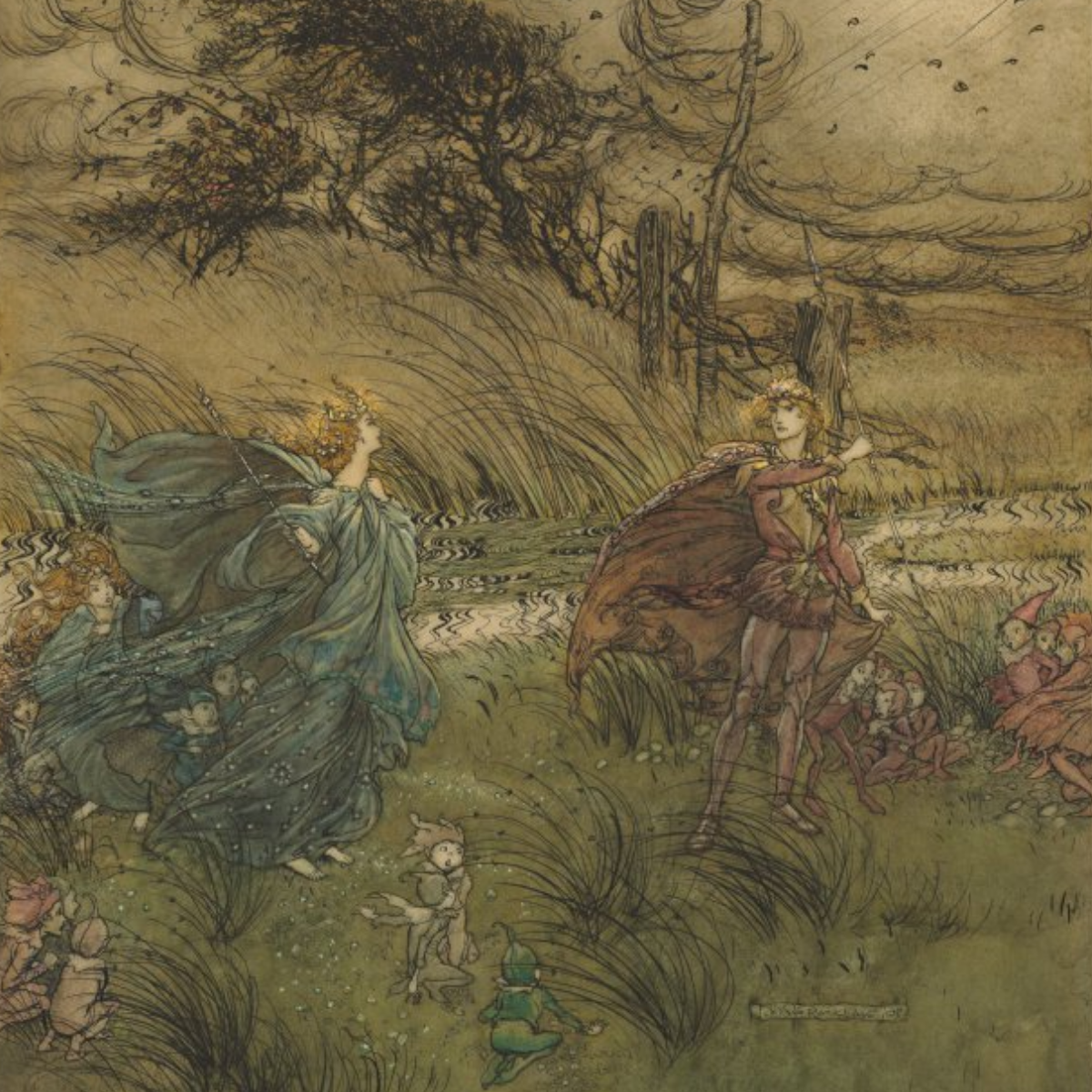
Art credit (featured image): And Now They Never Meet in Grove or Green by Arthur Rackham via The Cleveland Museum of Art, licensed under CC0