This last spring I spent a lot of time researching the Tylwyth Teg (the Welsh faeries). In fact, I took so many notes that I ended up with enough material for four posts! In case you’re relatively new to my blog, here are links to the first two articles I wrote on the Welsh faeries: the Tylwyth Teg and Annwn and the folklore of the Tylwyth Teg.
This will be the third post written from those notes, and we’ll be exploring faerie rings and the faerie passion for dancing. While the information I’ll be sharing in this post will have a Celtic and British faerie folklore emphasis, faerie rings and dancing are found in many faerie traditions. We’ll discuss what faerie rings are, what might have happened to someone who stepped into a faerie ring, and how to help someone escape who is trapped dancing with the faeries.
What Is a Faerie Ring?
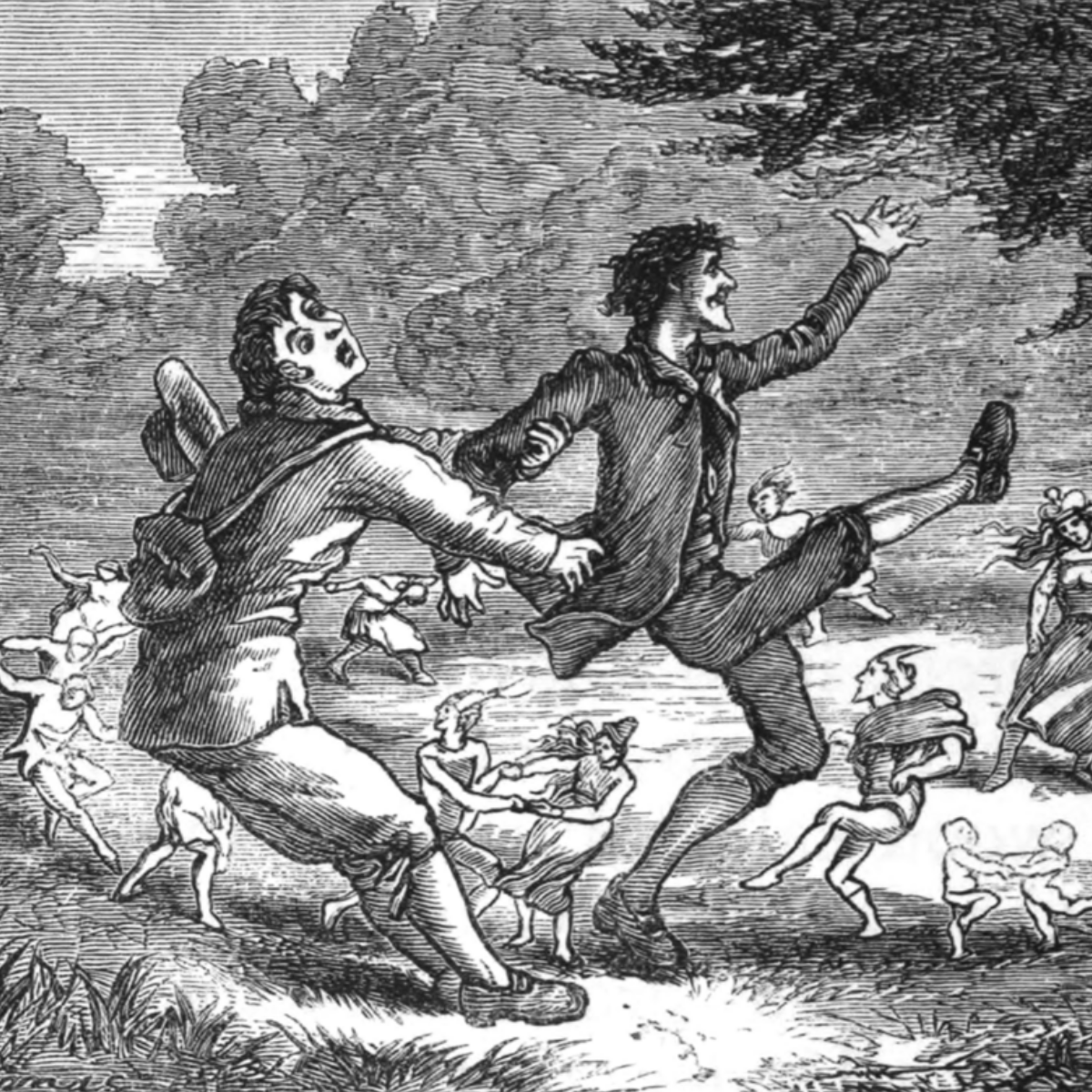
Dancing seems to be one of the faeries’ favorite pastimes. (Full confession: as someone who loves to go dancing, I can relate!) References to faeries dancing are found in folklore collections, as well as in literature and art. Faeries are often described as dancing in what are known as faerie rings (or faerie circles). In the Welsh tradition, these faerie rings are generally described as being a green ring or circle in the grass.
Most folklore I came across cautioned against entering a faerie ring. Farmers hesitated to plow through faerie rings for fear of misfortune. I found multiple references warning folks not to even step or place a foot into a ring. In Folk-Lore of Shakespeare, T. F. Thiselton Dyer explains that by stepping foot into a ring a human might “be liable to the fairies’ power.”
Apparently animals may have been wary of faerie rings as well. Thiselton Dyer quotes the following passage from William Shakespeare’s The Tempest, in which Prospero speaks of the faeries:
… you demi-puppets, that
By moonshine do the green-sour ringlets make,
Whereof the ewe not bites; and you, whose pastime
Is to make midnight mushrooms; … (5.1.45-8)
Thiselton Dyer notes that in these few words Shakespeare not only describes the faeries’ moonlit dance, but also adds in a layer of warning regarding the “green-sour” faerie rings: sheep won’t eat the grass which grows there. In his discussion of faerie rings, Thiselton Dyer also explains how the fear of faerie rings played into another folk belief—using May dew as part of a beauty routine. He writes:
Among the numerous superstitions which have clustered round the fairy rings, we are told that when damsels of old gathered the May dew on the grass, which they made use of to improve their complexions, they left undisturbed such of it as they perceived on the fairy-rings, apprehensive that the fairies should in revenge destroy their beauty.
I find it this overlapping of folk beliefs interesting, as well as the fact that possible faerie interference should put a damper on human activities and customs. I did a little more digging into contemporary views on faerie rings, and I learned that much of the folklore surrounding rings is actually rooted in nature.

In the article “What’s causing the circles in my lawn? Fairy rings,” Ken Johnson explains that rings of green grass or mushrooms growing in a circle are actually due to soil-dwelling fungi. He notes that while the most common fungus to create these rings is “a small, tan species called the fairy ring fungus, Marasmius oreades,” there are actually about fifty different species of fungi that can create faerie rings. He writes:
The fungi do not attack grass roots; they feed on decaying organic matter (tree stumps, roots, thatch, construction debris, etc.) buried in the soil. As the fungi consume this material, they grow outward from a central point, typically forming a relatively uniform circular pattern. The rings typically range in size from 2 to 15 feet across but can reach over 50 feet.
The end result can create three different types of faerie rings: a dark-green ring of grass, a ring of dead grass, or a circle of mushrooms. I still wondered, though, if human and animal avoidance of faerie rings signified any type of danger (other than faeries), so I searched for potential reasons for that. According to “Fairy Ring Mushroom: Identification, Foraging, and Edibility,” Marasmius oreades is both a common and edible mushroom; however, it has dangerous lookalikes. The post explains:
Some of these lookalikes are toxic and can cause serious health issues if consumed. It is crucial to differentiate between the fairy ring mushroom and its lookalikes to ensure safe consumption.
So perhaps the potential danger of accidentally eating a toxic, lookalike mushroom lurked behind the folklore of avoiding faerie rings. Nevertheless, while it might have been easy to steer clear of a faerie ring itself, what might have happened if you came upon faeries while they danced in the ring?
The Allure of Faeries Dancing in a Ring
Let’s suppose for a moment that you and a friend decide to take a midnight stroll out in a nearby pasture. The full moon lights your way, and you hear lively music on the wind. Off in the distance, beautiful people dance and sing in a circle. Their music is intoxicating, alluring, hard to resist. Should you join in? It’s just dancing and lovely music after all …
While it may seem so tempting, I might recommend that you and your friend simply watch from a distance. In Celtic Folklore: Welsh and Manx, John Rhŷs describes the perils of getting too close to the Tylwyth Teg while they were dancing:
Many [people] used to go to look at them [Tylwyth Teg] on those nights, but it was dangerous to go too near them, lest they should lure the spectator into their circle; for if that happened, they would throw a charm over him, which would make him invisible to his companions, and he would be detained by the fairies as long as he lived. At times some people went too near to them, and got snatched in; and at other times a love-inspired youth, fascinated by the charms of one of their damsels, rushed in foolhardily to try to seize one of them, and became instantly surrounded and concealed from sight.
I want to bring attention to one of Rhŷs’ points above, and that is the belief that a person caught in a faerie ring might be trapped there for the rest of their life. In my research, I did encounter methods for helping someone escape a faerie ring, and we’ll explore that topic shortly, but many stories relate how entering a faerie ring resulted in a person becoming trapped in the land of Faerie. Faerie music could enthrall a person (much like faerie food), and it was considered to be dangerous.

Faerie Rings Are Liminal Spaces
While researching faerie rings, I encountered an interesting discussion that explores the experience of being in a faerie ring. I found it kind of fascinating, and so I want to share it with you, plus add my own thoughts on the topic.
Let’s return to the imagined midnight outing, where you and a friend see faeries dancing in the distance. As exciting as the dance seems, you know to stay away, but your friend gets drawn in. (Or maybe you’d rather be the one to run off with the faeries? I don’t wish to presume, but I do need someone to stay behind for the story to be properly told. 😉)
To continue, the faeries and your friend suddenly disappear from sight, and you begin to worry. You’ve heard tales of folks being trapped with the faeries for a year or more, but if they’re able to escape, they’re curiously under the impression that they’ve only been gone a short while.
In the thesis “Y Tylwyth Teg: An Analysis of a Literary Motif,” Angelika Heike Rüdiger explores this time discrepancy between the human world and that of the land of Faerie. Rüdiger explains that a faerie ring was considered to be a liminal space (a place where you might meet otherworldly beings or enter an otherworldly realm), which was often accessible during liminal times of the day or year (such as “twilight and midnight and high noon” or during transitions between seasons). Additionally, dancers were subject to a liminal concept of time while dancing in the ring. They were “trapped in an eternal present of immortality.” Rüdiger writes:
The absence of time or the extremely slow flow of time in the otherworld turns its denizens and visitors into ‘ever-living ones’. But if time does not flow, then the past and the future collapse into an unending present. The dancers who stumble into a fairy ring, still dance one year later (as seen from the perspective of men) and they believe that only a moment has passed since they started to dance ….
When I read this, I immediately thought of two non-faerie things: relativity and the Q from Star Trek. I don’t want to get too deep into the weeds, but I do see a connection. I briefly did some research on relativity for this article, and I found a good example in “DOE Explains … Relativity.” In the article, they explain that “time is measured differently in different frames of reference” due to the fact that “different frames of reference perceive time and space differently.” I realize that faerie rings and outer space are not the same, but I do think the following example from the article helps to illustrate the liminal sense of time in faerie ring stories:
The classic example is a pair of twin astronauts. One twin stays on Earth, while the other climbs on a rocket going close to the speed of light. Both have their own frames of reference that are moving at different speeds. The Earth is moving around the sun, while the rocket is accelerating away from the Earth. The twin on the rocket will experience time differently than the one on Earth. In fact, she will experience much less time overall than the one on Earth, called time dilation. When she returns to Earth, she will be significantly younger than her twin.
It’s a little uncanny how similar this sounds to how time and aging is described in faerie ring folktales. In addition to the difference in the flow of time between the human and faerie realm, Rüdiger’s thesis also describes a common folklore motif where people who enter Faerie don’t age or develop. They are essentially stuck in an “eternal present of the Otherworld.”
This thought connection of faerie rings and relativity also brought to mind the Q from Star Trek. (If you’re not familiar with Q, the Q, or the Q Continuum, this wiki provides an introduction.) Much like faeries, the Q live in an alternate dimension and can be tricksters who cause chaos. I actually see a lot of similarities between faeries and the Q, but that’s a whole other post.
How to Escape a Faerie Ring
While I digressed on the topics of relativity and the Q, your poor friend remains trapped and endlessly dancing with the faeries! Luckily, in my research I’ve discovered that there are several ways for you to help your friend escape. It seems fairly straightforward, but we first need to return to the concept of liminal time experienced inside of the faerie ring. Rüdiger writes:
In these tales choosing the correct time to free the prisoners from the otherworld becomes a crucial issue. Not only does time flow differently … but the time of the otherworld is not presented as a continuous flow from a distant past to a distant future but passes cyclically. When the magical period of a year or a year and a day have passed, a person can be freed from the otherworld, ….
Rüdiger explains that much like the seasons, where every year spring begins again in a cycle, so too can you briefly access your friend in the faerie ring at the end of the “magical period.” Once the year or the year and a day has passed (generally the tale will mention a specific time frame), you must return to the precise place where your friend was pulled in. Your friend will pass by—still dancing—and you will have the opportunity to free them.

In his book, Rhŷs mentions a few ways folks in the mundane world saved a person from the faerie dance. One way was to hold out “a long stick of mountain ash” with the far end in the middle of the faerie ring. When the trapped person “came round in his turn in the dance he might take hold of it, for he is there bodily though not visible, so that he cannot go past without coming across the stick.” Hopefully the person would grab hold of the stick so that they could be pulled out. Rhŷs notes that mountain ash served as a protection against faeries and other spirits—they wouldn’t “dare touch” it.
In a similar fashion, he describes how iron (which was also used to ward off faeries) was used to pull folks from a faerie ring. He writes:
There the fairies used to dance, and when a young man got into one of the rings the fairy damsels took him away; but he could be got out unharmed at the end of a year and a day, when he would be found dancing with them in the same ring: he must then be dexterously touched by some one of his friends with a piece of iron and dragged out at once. This is the way in which a young man whom my notes connect with a place called Bryn Glas was recovered. He had gone out with a friend, who lost him, and he wandered into a fairy ring. He had new shoes on at the time, and his friends brought him out at the end of the interval of a year and a day; but he could not be made to understand that he had been away more than five minutes, until he was asked to look at his new shoes, which were by that time in pieces.
I think this is one of my favorite faerie ring tales due to its specificity and its inclusion of many motifs associated with this type of tale. I especially love how the man’s shoes reveal the truth of his time with the faeries. Plus, other than his shoes, he seems no worse for wear for spending a year and a day with the faeries. If I were writing the tale of you and your friend, I would pen a hopeful ending such as this.
However, while many faerie ring tales do have relatively happy endings for the person saved from the ring, I must warn you that there are some stories that end tragically. Rüdiger notes that at times when the person is helped out of the ring, “they do not live long or even crumble to dust.” Elias Owen includes quite a few faerie ring tales in Welsh Folk-Lore: A Collection of the Folk-Tales and Legends of North Wales. They are too long to include here, but in several the person who was saved from the ring died soon after eating food in the mundane world.
I’m not sure what to make of this inconsistency. Rüdiger writes that the liminal faerie world allows for different, coexisting opportunities when it syncs with the mundane world—humans can enter or be brought into Faerie, or they may have the chance to escape it. Perhaps in a similar way, spending time in the liminal world can affect human bodies in different, coexisting ways.
A Final Thought on Faerie Ring Tales
I’ve been thinking a lot about how these stories often include a companion who witnesses their friend’s disappearance and helps to free them. On the surface, this may seem like a simple plot device to save the friend from the enthralling dance with the faeries. But folktales aren’t necessarily plotted out; they often come from oral tradition and include customs and cultural beliefs.
It seems to me that the inclusion of a companion in these tales might have served as a warning to listeners to not go out walking alone in the middle of the night. I’ve come across other tales and folklore that seem to issue safety reminders or serve as cautionary tales, and faerie ring stories might have been used for that purpose as well.
I hope you enjoyed exploring faerie ring folklore and tales with me!
As ever, thank you for reading my blog. If you know someone fascinated by faeries, feel free to share this post with them.
PS: While researching for this post, I discovered that Q gave out his phone number on an episode of Star Trek: Picard. If you call, you are rewarded with a recorded message from Q (John de Lancie). The number is (323) 634–5667, and of course I called. So fun!
Art credit (featured image): Plucked from the Fairy Circle by T. H. Thomas from British Goblins: Welsh Folk-Lore, Fairy Mythology, Legends and Traditions by Wirt Sikes, via Wikimedia Commons, public domain