As I research folklore topics for my newsletter, blog, and creative work, I frequently come across Dafydd ap Gwilym’s poetry. Because I came to creative writing through poetry, I was curious to learn more about him. So I thought, what better way to accomplish this than to do a little research for this post!
Dafydd ap Gwilym was a Welsh nobleman who lived during the fourteenth century and is often considered by scholars to be one of the great medieval poets. His poems cover a range of topics from love to nature to elegies.
I am drawn to his poetry for a variety of reasons. At first I was attracted to his skill at weaving nature and folklore into his poems. No surprise! But, I was intrigued to learn that he uses structured verse forms in a way that enhances meaning and allows for discussion. I’m also fascinated by the way he incorporates social customs into his love poems, which helps to reveal complicated relationships.
Much of what is known about Dafydd ap Gwilym comes from his poetry itself, so rather than delve into his history, I’ll include some aspects of his life as I meander through the topics I listed above. Even if poetry isn’t your jam, perhaps as we go along you’ll find reasons to explore his poetry as well. Let’s jump in with the first reason to love (or not love) his poems. 🙂
1. Nature Is Often His Muse
Dafydd ap Gwilym seems to have been inspired by the natural world of the rural community where he was born. Within his poetry are references to nature in various forms: birds, deer, domesticated animals, the fox, trees, clover, streams, the mist, etc. In Dafydd ap Gwilym: The Poems, Richard Morgan Loomis provides both an English translation of Dafydd ap Gwilym’s poems and an introduction to the poet and his work. Loomis explains that it is thought that Dafydd ap Gwilym was likely born at Bro Gynin (in the county of Ceredigion), and that by growing up in this region, Dafydd would have encountered not only animals on farms and crops grown in cultivated fields, but also the wilderness and the natural elements.
Loomis notes that the natural world serves a variety of functions in Dafydd ap Gwilym’s poems. He observes that sometimes the purpose is descriptive—the landscape serves as a setting, and its inhabitants are used literally as natural elements within the scene of the poem. At other times, Loomis perceives nature functioning as a character in its own right and acting as a messenger.
In addition, Loomis mentions that in some of the poems featuring nature, Dafydd uses a literary device known as dyfalu, which is a method of describing something through many comparisons. He notes that the poem, “Love Compared to a Hare,” includes a good example of dyfalu—Dafydd ap Gwilym uses the first 42 lines of the poem to describe the hare, often through other aspects of nature.

I often come across desert cottontails on the wilderness trails near my home (and on my lawn!), so I found this particular example of dyfalu very relatable. Plus I feel like using dyfalu could be a fun poetry exercise to practice and explore writing description, but we could keep it more manageable by starting with 5-10 lines of comparison, rather than 42.
2. Dafydd ap Gwilym Brings in Folklore
The fact that Dafydd ap Gwilym often alludes to the folklore of Wales is how I first came to learn about his poetry. Folklore collections and scholars often quote from his poems as medieval examples of early faerie tradition.
In many of his poems Dafydd ap Gwilym references Gwyn ap Nudd, king of the Tylwyth Teg (the Welsh faeries) and Annwn (the Welsh otherworld), as well as characters and tales from the Mabinogion and Arthurian legend. In the thesis “Y Tylwyth Teg: An Analysis of a Literary Motif,” Angelika Heike Rüdiger notes that often in his references to Gwyn ap Nudd and Annwn, Dafydd depicts the Welsh faerie world as behaving in a mischievous manner and capable of devising vexing situations.
One poem Rüdiger cites as an example is “The Mist,” in which the protagonist is kept from visiting his love due to a heavy mist. Not only does the poem allude to Gwyn ap Nudd and Annwn, it also reveals a connection between the mist and the Tylwyth Teg. Additionally, Rüdiger observes that Dafydd ap Gwilym uses dyfalu to reveal the mist’s nature more fully.
Through folkloric allusions and references to characters and events from other texts and legends, Dafydd ap Gwilym communicates context and mood quickly and draws connections between seemingly disparate (at first) topics. I enjoy nuanced writing like this, which might challenge me as a reader to learn more about the allusion or reference being made in order to deepen my understanding of the writing.
3. He’s Not Afraid of Structure
In writing forums I often encounter debates about whether or not to structure creative work (in the form of outlining, plotting, character arcs, meter, rhyme, etc.). Some folks prefer to write with some structure in place, while others do not. So when I learned that not only did Dafydd ap Gwilym use structured verse forms, but he leaned into it, I added it to my list of why a reader might love (or not love) his poetry.
According to Loomis, Dafydd ap Gwilym uses a variety of Welsh poetic forms including traethodl, englyn, and awdl, but most of his poems follow the cywydd deuair hirion form (often referred to as just cywydd or the plural cywyddau). Loomis provides a clear definition of the cywydd form, which consists of “… rhyming couplets of seven-syllable lines; the rhymes are on alternating accented and unaccented final syllables (as in the English, den, hidden); ….” Additionally, each line should display cynghanedd, which involves repeating sounds in the line using specific rules (this may sound straightforward, but there are several different types of cynghanedd, and it can be quite intricate).

I would say that writing the cywydd form is not for the faint of heart. In “Extreme Welsh Meter,” Gwyneth Lewis likens Welsh meters to “an extreme sport,” but notes that it’s important to know of them because they’re still being used by poets today.
Because writing within such structure can be challenging, Loomis mentions that Dafydd ap Gwilym (and other Welsh poets) employ devices to ease the demands of cynghanedd. He explains that the poets use different types of interruptions (like parenthetical asides and separating words that form names) to more easily achieve the repetition of sounds required.
These interruptions end up having an intriguing effect on the poem. Loomis explains that it often complicates the poem, but in a good way—it allows for showing the interior feelings of the speaker of the poem, it can deepen meaning, and it can allow for debate or conversation on a topic.
I suppose many writers strive for work that provides several layers which operate simultaneously. I find it very appealing to read writing that offers deeper meaning as you pull back each layer. I also like that purposeful structure can provide a framework for creative work and at the same time encourage creativity as the writer works within the structure. I sometimes think that structure gets a bad rap. Perhaps it doesn’t have to be seen as limiting; rather, it might be viewed as a potential way to access creativity.
4. He Employs the Window Love Trope (Which Is Actually Based on a Social Custom)
If you’re still reading (which I hope you are!), hear me out. 😉 I know the word “trope,” like “structure,” can be polarizing with respect to writing. But I did find it interesting to learn that Dafydd ap Gwilym incorporates window wooing scenarios in some of his love poems. We often see similar types of scenes in contemporary books, movies, and television shows where lovers are separated by a window, talking through a window, or calling up / down through an upstairs window. I often think of these as variations on the balcony wooing scene in Romeo and Juliet.
I’m not sure of the precise origin of this type of scene, but it seems to be older than Shakespeare if Dafydd ap Gwilym is including it in his poetry. He incorporates night visits to a woman’s window in several poems; for example, in one a jealous husband hears the protagonist tapping at the window, in another the protagonist is refused entry through a window by a woman.

In reading Loomis’ introduction to his translation of the poems, it is clear that Dafydd ap Gwilym had a very complicated relationship with love and women. I’m not sure if he engaged in night visits himself, but in my research I learned that night courtship was a Welsh custom that dated back to the Middle Ages. In The Welsh People, John Rhŷs and David Brynmor-Jones explain that courting at night was a custom in some agricultural areas in Wales. They write:
It is frequently referred to in the poems of the fourteenth-century Welsh poet D. ab Gwilym, and it may be briefly described thus: the lover sallies forth at night and approaches the house where his fair one lives; then he attracts her attention by gently tapping at her window.
They further note that the lovers might speak through the window, which could result in allowing the lover to enter in order to sit and talk through the night. This is not the only social custom related to love that is reflected in Dafydd ap Gwilym’s poetry, but I found it particularly interesting because it shows up in popular culture still today.
Thanks so much for joining me to learn about Dafydd ap Gwilym! If you’re interested in reading more about his life, poetry, (or his struggles with love), I do recommend Richard Morgan Loomis’ translation, Dafydd ap Gwilym: The Poems. It’s free to read at the link I’ve provided because it’s part of a not-for-profit research project. I found the introduction to be really interesting and helpful to read before exploring the poems themselves.
As ever, thank you for reading my blog. If you know someone fascinated by folklore (or poetry!), feel free to share this post with them.
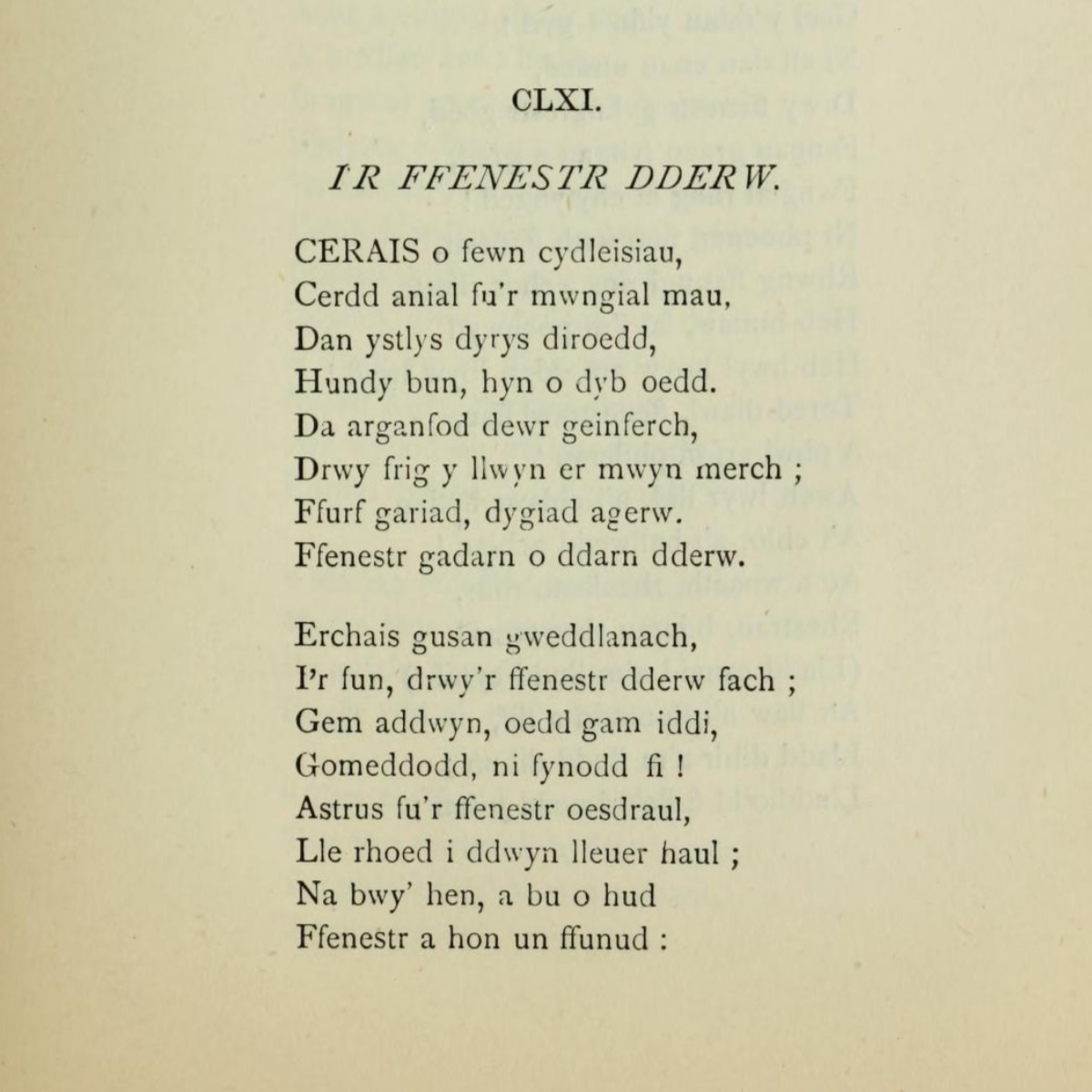
Art credit (featured image): image of a cropped portion of a poem from a page in Barddoniaeth Dafydd ab Gwilym via Internet Archive, public domain.